Analytical solution for the polydisperse random close packing problem in 2D
This paper presents an analytical theory for the random close packing density of polydisperse hard disks, providing a solution based on an equilibrium model of crowding. The theory predicts $\phi_\textrm{RCP}$ as a function of the size distribution's standard deviation ratio, $s$, and aligns well with recent numerical estimates.
Abstract
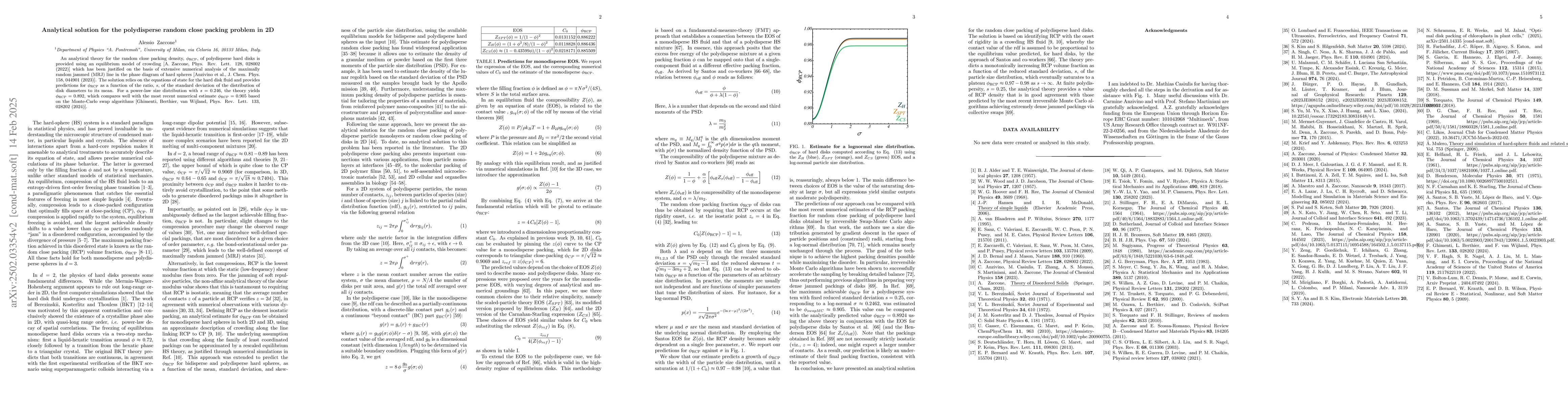
An analytical theory for the random close packing density, $\phi_\textrm{RCP}$, of polydisperse hard disks is provided using an equilibrium model of crowding [A. Zaccone, Phys. Rev. Lett. 128, 028002 (2022)] which has been justified on the basis of extensive numerical analysis of the maximally random jammed (MRJ) line in the phase diagram of hard spheres [Anzivino et al., J. Chem. Phys. 158, 044901 (2023)]. The solution relies on the equations of state for the hard disk fluid and provides predictions for $\phi_\textrm{RCP}$ as a function of the ratio, $s$, of the standard deviation of the distribution of disk diameters to its mean. For a power-law size distribution with $s=0.246$, the theory yields $\phi_\textrm{RCP} =0.892$, which compares well with the most recent numerical estimate $\phi_\textrm{RCP} =0.905$ based on the Monte-Carlo swap algorithms [Ghimenti, Berthier, van Wijland, Phys. Rev. Lett. 133, 028202 (2024)].
Analysis
AI-generated · verify against the original paper
Generated Jun 11, 2025ResultsWhat the authors found
- An analytical solution for $\phi_{\textrm{RCP}}$ of 2D polydisperse particles is provided.
- For a power-law size distribution with $s=0.246$, the theory predicts $\phi_{\textrm{RCP}} = 0.892$, close to the numerical estimate of $0.905$ from Monte-Carlo swap algorithms.
LimitationsWhere the findings need caution
- The theory is based on specific equilibrium models for bidisperse and polydisperse hard spheres.
- The predictions depend on the choice of equation of state (EOS) for monodisperse and polydisperse disks.
MethodologyHow the work was done
The research presents an analytical theory for the random close packing density ($\phi_{\textrm{RCP}}$) of polydisperse hard disks using an equilibrium model of crowding, validated by extensive numerical analysis of the maximally random jammed (MRJ) line in the phase diagram of hard spheres.
SignificanceWhy the work matters
This work is significant as it offers a theoretical approach to estimate the density of granular media or powders based on the first three moments of the particle size distribution, applicable in various fields such as material science, geology, and biology.
Technical contributionsWhat the work introduces
The paper introduces an analytical solution for polydisperse random close packing in 2D, linking it to equilibrium models of crowding and the MRJ line in hard sphere phase diagrams.
NoveltyHow it differs from prior work
This research presents the first analytical solution for the 2D polydisperse close packing problem, connecting it to various applications from granular materials to biological assemblies.
Future workQuestions that remain
- Further exploration of different particle size distributions and their impact on $\phi_{\textrm{RCP}}$.
- Validation of the theory with additional experimental data.
Discussion 0