Asymmetric Multimodal Learning: The Alignment Redundancy Bound and Decomposed JEPAs
Abstract
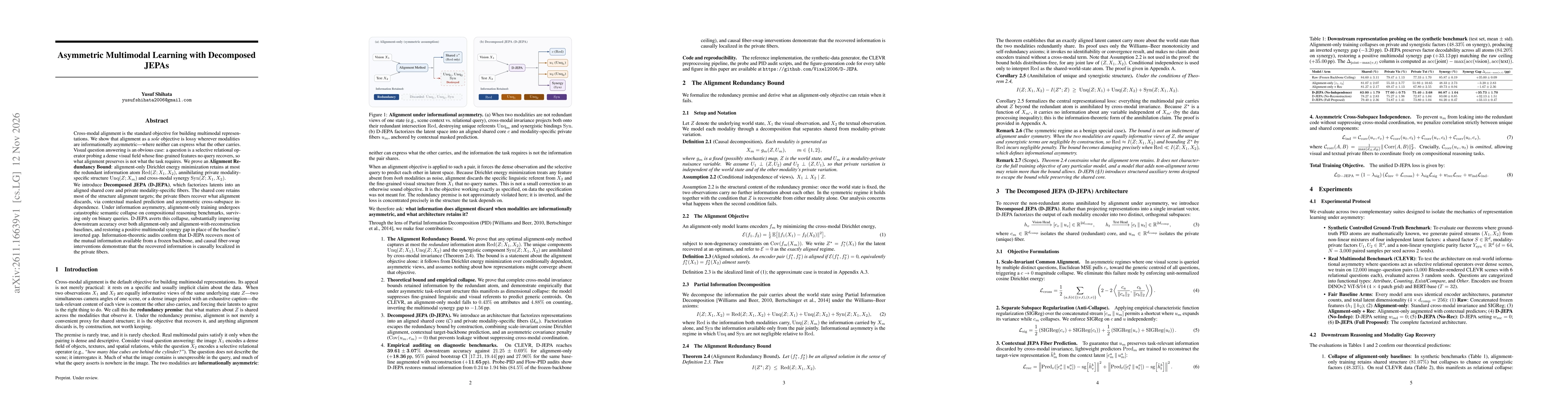
Cross-modal alignment is the default objective for multimodal representation learning, but it rests on an implicit assumption: that the two modalities are roughly symmetric views of the same underlying state. We show that this assumption fails on real multimodal data, and that alignment as a sole objective is provably lossy under informational asymmetry. We formalize the failure through Partial Information Decomposition, proving that cross-modal alignment retains at most the redundant information atom and annihilates the modality-unique and synergistic structure on which asymmetric tasks depend. We give the exact PID decomposition of the alignment information bottleneck, characterize its failure regime, and derive a sufficiency condition that any encoder objective must satisfy to preserve all four informational atoms. We then introduce Decomposed JEPA (D-JEPA), which realizes this condition by factorizing each modality's latent space into an aligned shared core and a private fiber anchored by contextual masked prediction. On compositional reasoning benchmarks, alignment-only training undergoes catastrophic semantic collapse on relational queries; D-JEPA prevents this collapse, recovering the referent structure alignment discards, restoring most of the mutual information available from a frozen backbone, and producing positive multimodal synergy where alignment inverts it. Information-theoretic and causal audits confirm that the recovered information is causally localized in the private fibers.
Analysis
AI-generated · verify against the original paper
Generated Jan 1, 0001ResultsWhat the authors found
- Alignment‑only training suffers catastrophic semantic collapse on compositional reasoning benchmarks, achieving only 0.43% attribute accuracy on CLEVR.
- D‑JEPA improves downstream CLEVR accuracy to 39.61% ± 3.07%, a gain of +18.36 percentage points over alignment‑only and +11.65pp over alignment‑with‑reconstruction baselines.
- Information‑theoretic audits show D‑JEPA recovers mutual information from 0.24 to 1.94 bits (84.5% of the frozen backbone).
- Probe‑PID and Flow‑PID analyses demonstrate that D‑JEPA restores private‑unique and synergistic information components that are annihilated by alignment‑only models.
MethodologyHow the work was done
The paper proposes Decomposed JEPA (D-JEPA), an architecture that factorizes multimodal latents into an aligned shared core and private modality‑specific fibers. It combines scale‑invariant cosine Dirichlet alignment, contextual masked prediction, and an asymmetric covariance penalty (Cov(u_m, c)=0) to enforce cross‑subspace independence while preserving private information.
SignificanceWhy the work matters
The work reveals that pure cross‑modal alignment discards essential private and synergistic information in asymmetric settings, and introduces a principled architecture that retains this information, enabling substantially better performance on tasks requiring fine‑grained multimodal reasoning.
Technical contributionsWhat the work introduces
Introduces the Alignment Redundancy Bound proving that alignment‑only objectives retain at most the redundant information atom, and designs D‑JEPA to explicitly capture the unique and synergistic components via latent factorization and independence constraints.
NoveltyHow it differs from prior work
First to decompose JEPA representations into shared and private fibers for asymmetric multimodal learning, and to provide a theoretical bound linking Dirichlet energy minimization to information loss.
Discussion 0