Auditing a superconducting database built by a large language model
Abstract
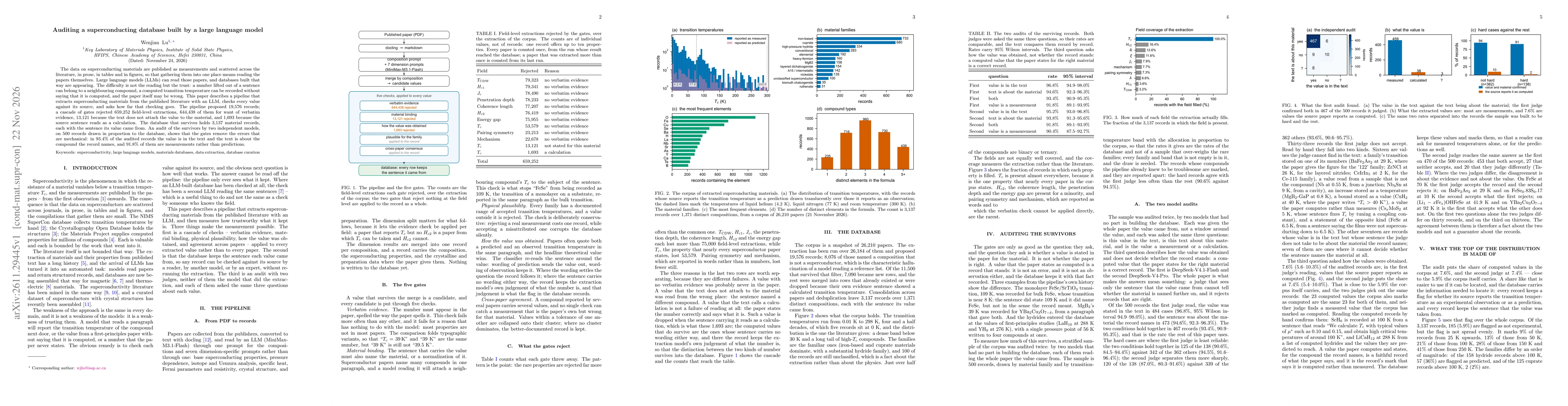
The data on superconducting materials are published as measurements and scattered across the literature, in prose, in tables and in figures, so that gathering them into one place means reading the papers themselves. Large language models (LLMs) can read those papers, and databases built that way are appearing. The difficulty is not the reading but the trust: a number lifted out of a sentence can belong to a neighbouring compound, a computed transition temperature can be recorded without saying that it is computed, and the paper itself may be wrong. This paper describes a pipeline that extracts superconducting materials from the published literature with an LLM, checks every value against its source, and asks how far that checking goes. The pipeline proposed 19,576 records; a cascade of gates rejected 659,252 field-level extractions, 644,438 of them for want of verbatim evidence, 13,121 because the text does not attach the value to the material, and 1,693 because the source sentence reads as a calculation. The database that survives holds 3,137 material records, each with the sentence its value came from. An audit of the survivors by two independent models, on 500 records drawn in proportion to the database, shows that the gates remove the errors that are mechanical: in 93.4% of the audited records the value is in the text and the text is about the compound the record names, and 91.8% of them are measurements rather than predictions.
AI Key Findings
Get AI-generated insights about this paper's methodology, results, significance, and more — available when analysis has been generated.
Discussion 0