AutoScientist-Quant: Self-Evolving Coding Agents for Automatic Research in Quantitative Investment
Abstract
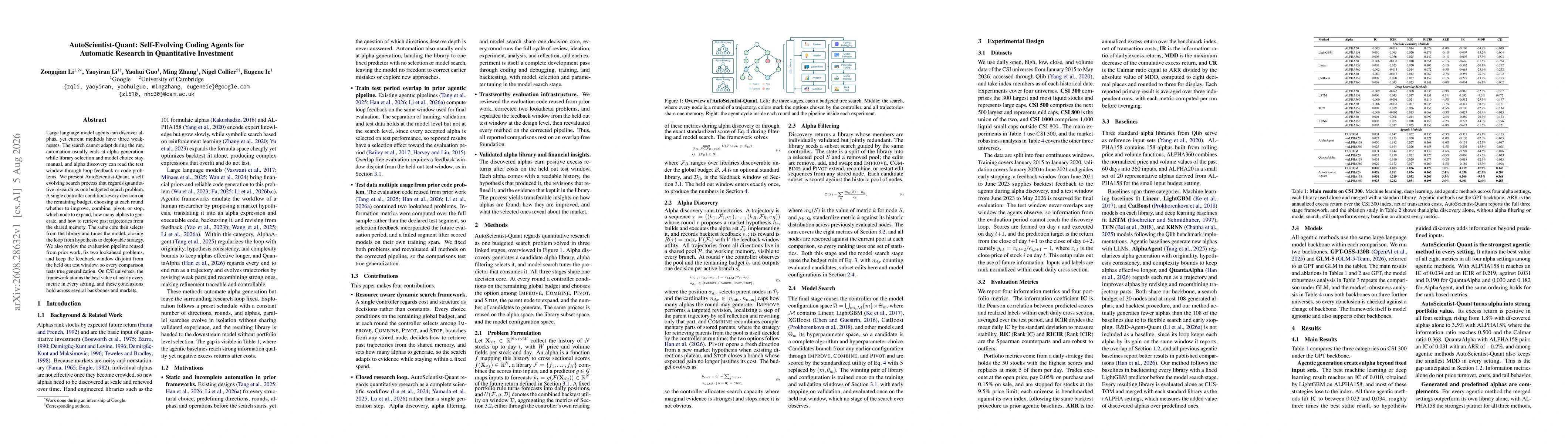
Large language model agents can discover alphas, yet current methods have three weaknesses. The search cannot adapt during the run, automation usually ends at alpha generation while library selection and model choice stay manual, and alpha discovery can read the test window through loop feedback or code problems. We present AutoScientist-Quant, a self evolving search process that regards quantitative research as one budgeted search problem. A single controller conditions every decision on the remaining budget, choosing at each round whether to improve, combine, pivot, or stop, which node to expand, how many alphas to generate, and how to retrieve past trajectories from the shared memory. The same core then selects from the library and tunes the model, closing the loop from hypothesis to deployable strategy. We also review the evaluation pipeline reused from prior work, fix two lookahead problems, and keep the feedback window disjoint from the held out test window, so every comparison tests true generalization. On CSI universes, the framework attains the best value of nearly every metric in every setting, and these conclusions hold across several backbones and markets.
Analysis
AI-generated · verify against the original paper
Generated Jan 1, 0001ResultsWhat the authors found
- On CSI universes the framework attains the best value of nearly every metric in every setting.
- The superior performance holds across several backbone models and market datasets.
- Discovered alphas yield positive excess returns after costs on the held‑out test window.
MethodologyHow the work was done
AutoScientist-Quant treats quantitative research as a budgeted search problem controlled by a single controller that conditions every decision on the remaining global budget. At each round the controller selects actions (IMPROVE, COMBINE, PIVOT, STOP), chooses which node to expand, determines how many alphas to generate, and retrieves past trajectories from shared memory. The same core also selects libraries and tunes models, closing the loop from hypothesis generation to deployable strategy, and uses a corrected evaluation pipeline with disjoint feedback and test windows.
SignificanceWhy the work matters
The work demonstrates that a fully automated, budget‑aware search can reliably discover profitable trading alphas while ensuring true out‑of‑sample generalization through an overlap‑free evaluation, thereby advancing the automation of end‑to‑end quantitative research.
Technical contributionsWhat the work introduces
Introduces a unified controller that dynamically allocates budget across search actions, integrates library selection and model tuning into the same decision process, and provides a trustworthy evaluation infrastructure that eliminates look‑ahead bias and test‑train overlap.
NoveltyHow it differs from prior work
First system to combine a self‑evolving, budget‑conditioned search controller with a closed research loop and rigorously overlap‑free evaluation for quantitative investment alpha discovery.
Discussion 0