AZOWL AgentOps: Task-Scoped Governance for Deployed Agent Applications
Abstract
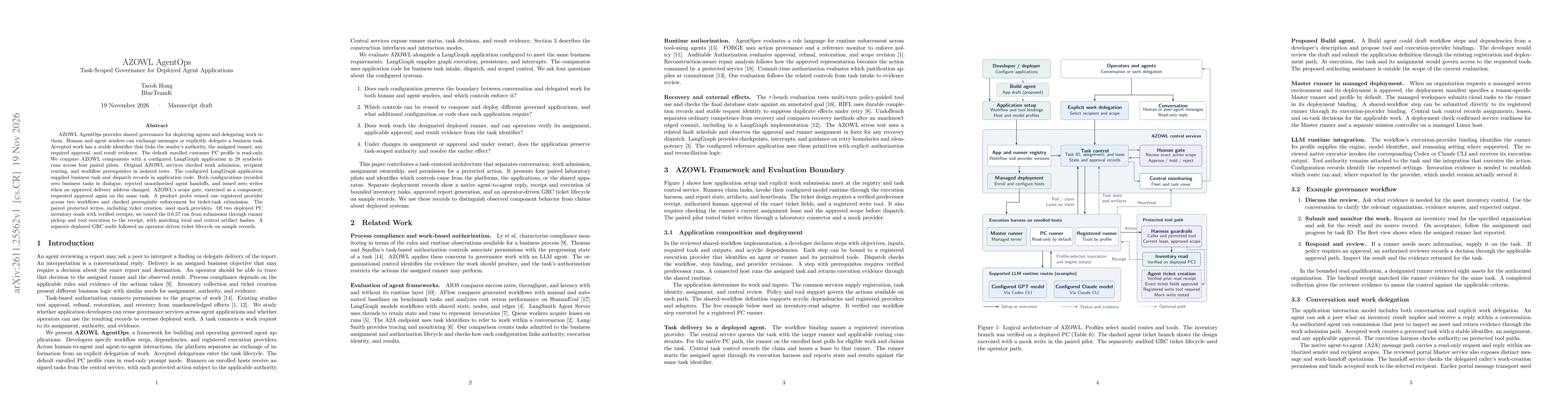
AZOWL AgentOps provides shared governance for deploying agents and delegating work to them. Human and agent senders can exchange messages or explicitly delegate a business task. Accepted work has a stable identifier that links the sender's authority, the assigned runner, any required approval, and result evidence. The default enrolled customer PC profile is read-only. We compare AZOWL components with a configured LangGraph application in 28 synthetic runs across four paired pilots. Original AZOWL services checked work admission, recipient routing, and workflow prerequisites in isolated tests. The configured LangGraph application supplied business task and dispatch records in application code. Both configurations recorded zero business tasks in dialogue, rejected unauthorized agent handoffs, and issued zero writes when an approved delivery address changed. AZOWL's scope gate, exercised as a component, requested approval again on the same task. A product probe reused one registered provider across two workflows and checked prerequisite enforcement for ticket-task submission. The paired protected writes, including ticket creation, used mock providers. Of two deployed PC inventory reads with verified receipts, we traced the 0.6.57 run from submission through runner pickup and tool execution to the receipt, with matching local and central artifact hashes. A separate deployed GRC audit followed an operator-driven ticket lifecycle on sample records.
Analysis
AI-generated · verify against the original paper
Generated Jan 1, 0001ResultsWhat the authors found
- Both AZOWL and LangGraph configurations recorded zero business tasks in dialogue, rejected unauthorized agent handoffs, and issued zero writes when an approved delivery address changed.
- AZOWL's scope gate component requested approval again on the same task, demonstrating re‑evaluation of authority.
- A product probe reused a registered provider across two workflows and successfully enforced prerequisite checks for ticket‑task submission.
- Protected writes, including ticket creation, were correctly handled using mock providers.
- Two PC inventory reads were traced end‑to‑end, showing matching local and central artifact hashes for run 0.6.57.
- A separate GRC audit confirmed the operator‑driven ticket lifecycle on sample records.
LimitationsWhere the findings need caution
- Recovery of business tasks after restart was not observed because the experimental connector was absent from that build.
- Some earlier runs showed incomplete recovery due to missing experimental connectors, limiting assessment of full fault‑tolerance.
MethodologyHow the work was done
The authors conducted 28 synthetic runs across four paired laboratory pilots, comparing AZOWL AgentOps components with a configured LangGraph application. They performed isolated tests of AZOWL services (work admission, recipient routing, workflow prerequisites) and used application code for business task intake and dispatch in the LangGraph setup. Additional experiments included mock providers for protected writes, provenance tracing of PC inventory reads, and a deployed GRC audit of an operator-driven ticket lifecycle.
SignificanceWhy the work matters
The study demonstrates that task‑scoped governance can be reliably applied to deployed LLM agent applications, ensuring authority, approval, and evidence are consistently linked to work assignments, thereby enhancing compliance and auditability in multi‑agent systems.
Technical contributionsWhat the work introduces
AZOWL AgentOps introduces a task‑centered architecture that separates conversational exchange from explicit work delegation, linking each delegated task to a stable identifier that captures the sender’s authority, assigned runner, required approvals, and result evidence.
NoveltyHow it differs from prior work
The paper presents a novel task‑scoped governance framework for deployed agent applications, enabling reusable governance services across heterogeneous agent systems while preserving clear boundaries between dialogue and delegated work.
Discussion 0