Bayesian Learning of Spatially Heterogeneous Causal Structure in Spatial Transcriptomics
Abstract
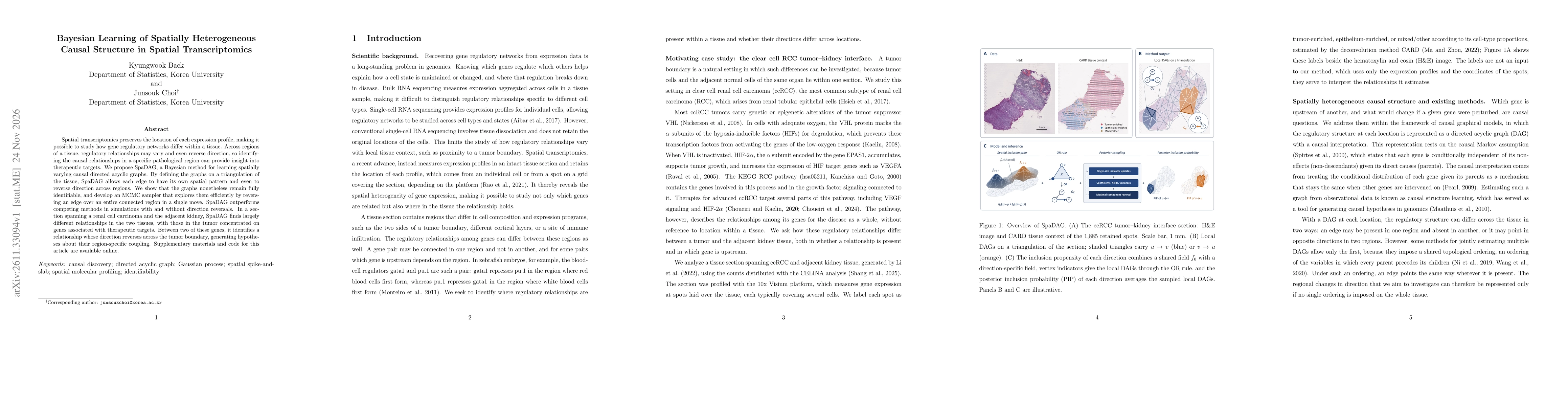
Spatial transcriptomics preserves the location of each expression profile, making it possible to study how gene regulatory networks differ within a tissue. Across regions of a tissue, regulatory relationships may vary and even reverse direction, so identifying the causal relationships in a specific pathological region can provide insight into therapeutic targets. We propose SpaDAG, a Bayesian method for learning spatially varying causal directed acyclic graphs. By defining the graphs on a triangulation of the tissue, SpaDAG allows each edge to have its own spatial pattern and even to reverse direction across regions. We show that the graphs nonetheless remain fully identifiable, and develop an MCMC sampler that explores them efficiently by reversing an edge over an entire connected region in a single move. SpaDAG outperforms competing methods in simulations with and without direction reversals. In a section spanning a renal cell carcinoma and the adjacent kidney, SpaDAG finds largely different relationships in the two tissues, with those in the tumor concentrated on genes associated with therapeutic targets. Between two of these genes, it identifies a relationship whose direction reverses across the tumor boundary, generating hypotheses about their region-specific coupling. Supplementary materials and code for this article are available online.
Analysis
AI-generated · verify against the original paper
Generated Jan 1, 0001ResultsWhat the authors found
- SpaDAG outperforms competing methods in simulations both with and without direction reversals.
- In a renal cell carcinoma section and adjacent kidney, SpaDAG discovers largely different gene‑regulatory relationships, with tumor relationships concentrated on therapeutic‑target genes.
- SpaDAG identifies a gene pair whose causal direction reverses across the tumor boundary, generating region‑specific hypotheses.
MethodologyHow the work was done
SpaDAG is a Bayesian approach that learns spatially varying causal directed acyclic graphs by defining the graph on a triangulation of the tissue; each edge can have its own spatial pattern and may reverse direction across regions, and inference is performed with an MCMC sampler that reverses an edge over an entire connected region in a single move.
SignificanceWhy the work matters
The method provides a way to uncover region‑specific causal gene‑regulatory networks in spatial transcriptomics, offering insights into disease mechanisms and potential therapeutic targets that vary across tissue locations.
Technical contributionsWhat the work introduces
Introduces a fully identifiable spatial DAG model with edge‑specific spatial patterns, proves identifiability, and develops an efficient MCMC sampler that updates edge directions over whole connected regions in one move.
NoveltyHow it differs from prior work
Allows each edge in a causal graph to have its own spatial pattern and to reverse direction across tissue regions, a capability not present in existing spatial causal discovery methods.
Discussion 0