Beyond Instance Slots: Semantically Rich World Models for Physical Interaction Planning
The paper introduces Semantically Rich World Model (SR-WM), a planning-focused world model that uses five functional roles (gripper, target, goal, relation, phase) to capture not just what objects are, but how they matter to a task. By extracting soft entity hypotheses from visual features and mapping them to roles, SR-WM predicts role transitions and semantics to support multi-candidate action generation, stage-aware reranking, and robust planning across LIBERO simulations and transfer scenarios.
Abstract
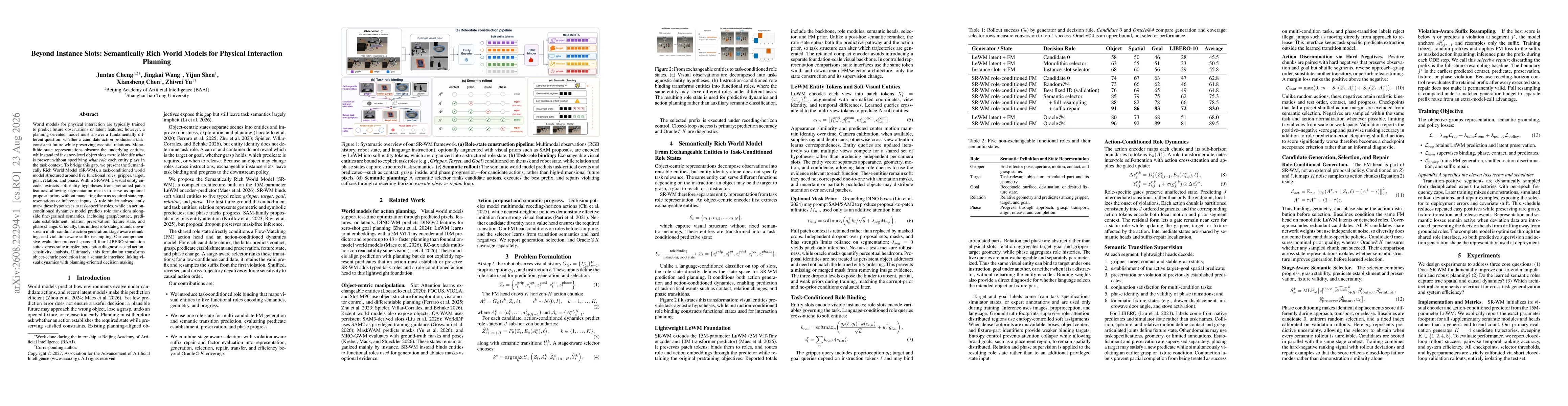
World models for physical interaction are typically trained to predict future observations or latent features; however, a planning-oriented model must answer a fundamentally different question: whether a candidate action produces a task-consistent future while preserving essential relations.Monolithic state representations obscure the underlying entities, while standard instance-level object slots merely identify \emph{what} is present without specifying \emph{what role} each entity plays in the task context. To bridge this gap, we present the Semantically Rich World Model (SR-WM), a task-conditioned world model structured around five functional roles: gripper, target, goal, relation, and phase.Within SR-WM, a visual entity encoder extracts soft entity hypotheses from pretrained patch features, allowing segmentation masks to serve as optional proposal priors without mandating them as required state representations or inference inputs.A role binder subsequently maps these hypotheses to task-specific roles, while an action-conditioned dynamics model predicts role transitions alongside fine-grained semantics, including grasp/contact, predicate establishment, relation preservation, fixture state, and phase change.Crucially, this unified role state grounds downstream multi-candidate action generation, stage-aware reranking, and violation-aware suffix resampling.Our comprehensive evaluation protocol spans all four LIBERO simulation suites, cross-suite transfer, perception diagnostics, and action-sensitivity analysis.Ultimately, this formulation transforms object-centric prediction into a semantic interface linking visual dynamics with planning-oriented decision making.
Analysis
AI-generated · verify against the original paper
Generated Jan 1, 0001ResultsWhat the authors found
- Closed‑loop success on LIBERO improves from 45.5% to 83.0% when using SemRole with the LEWM backbone.
- Closed‑loop success on RoboCasa rises from 42.9% to 55.2% with the pretrained Cosmos backbone.
- Real‑robot Galbot transfer success increases from 55.0% to 81.0% using SemRole.
MethodologyHow the work was done
SemRole is a semantic‑role‑structured world model that encodes task‑conditioned functional status of scene entities, their task‑relevant relations, and the current execution phase. It fuses language instructions, visual observations, and proprioception to produce a joint role state, which is used for action‑conditioned dynamics prediction, phase‑aware action selection, and local repair of invalid rollouts via prefix‑conditioned suffix repair.
SignificanceWhy the work matters
Explicitly modeling task‑semantic structure in world models yields substantially stronger manipulation performance across simulated and real‑robot domains, enabling more reliable planning and recovery from invalid action sequences.
Technical contributionsWhat the work introduces
Introduces a joint semantic‑role state that unifies participant binding, relational transitions, and phase context, and leverages this state for action generation, candidate selection, and a prefix‑conditioned suffix repair mechanism that locally fixes invalid rollouts.
NoveltyHow it differs from prior work
First world model that makes semantic roles the organizing principle for physical interaction planning, coupling task‑conditioned entity functions, relations, and execution phases within a unified predictive framework.
Discussion 0