Beyond Logits: Coherent Hallucination Mitigation via Attention Contrastive Decoding
Abstract
Large Vision-Language Models (LVLMs) demonstrate impressive multimodal capabilities, yet suffer from hallucination - generating factually inaccurate content. Contrastive Decoding (CD) mitigates this by contrasting amateur and expert branches at the logit level. However, our investigation reveals that such logit-level interventions fundamentally compromise generation coherence, necessitating restrictive penalty constraints unrelated to hallucination suppression. We introduce Attention Contrastive Decoding (ACD), a training-free plug-in that complements logit-level CD by relocating part of the contrastive operations to the attention mechanism. Operating at an earlier stage of the forward pass, ACD performs smooth semantic-preserving interventions through an Adaptive Subtraction Strategy (ASS), which attenuates hallucination-associated attention patterns while amplifying critical visual information. Extensive experiments demonstrate that combining ACD with existing CD methods (e.g., VCD+ACD) produces substantially more coherent outputs with further reduced hallucinations, eliminating restrictive penalties while enabling trustworthy multimodal generation.
Analysis
AI-generated · verify against the original paper
Generated Jan 1, 0001ResultsWhat the authors found
- Combining ACD with existing CD methods (e.g., VCD+ACD) yields substantially more coherent outputs and further reduces hallucinations compared to logit‑level CD alone.
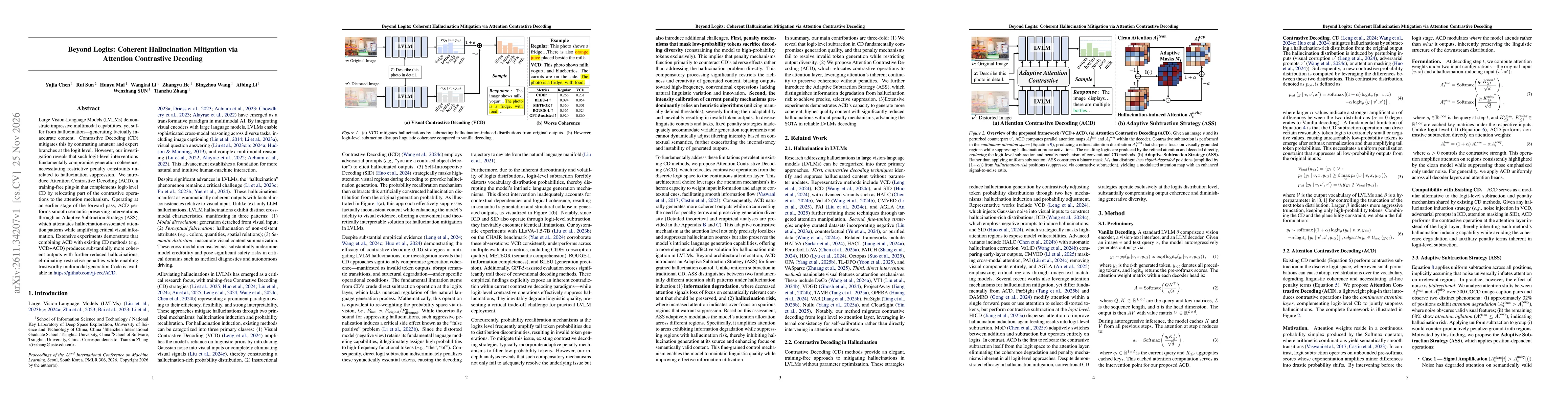
- Extensive experiments on LLaVA‑1.5‑7B using the CHAIR benchmark demonstrate that VCD alone underperforms across CIDEr, METEOR, ROUGE‑L, and BLEU metrics, while ACD mitigates these deficits.
LimitationsWhere the findings need caution
- The analysis is primarily conducted on a single model (LLaVA‑1.5‑7B) and benchmark (CHAIR), limiting generalizability to other LVLM architectures.
- While ACD alleviates coherence issues of logit‑level CD, it still relies on heuristic attention subtraction, which may not capture all contextual dependencies.
MethodologyHow the work was done
The paper proposes Attention Contrastive Decoding (ACD), a training‑free plug‑in that moves part of the contrastive operation from the logit layer to the attention mechanism, using an Adaptive Subtraction Strategy (ASS) to attenuate hallucination‑associated attention patterns while amplifying critical visual information, and combines ACD with existing logit‑level CD methods.
SignificanceWhy the work matters
ACD addresses the critical trade‑off between hallucination mitigation and linguistic coherence in large vision‑language models, enabling more trustworthy multimodal generation without restrictive penalty constraints.
Technical contributionsWhat the work introduces
Introduction of a training‑free attention‑based contrastive decoding plug‑in that performs smooth, semantic‑preserving interventions via adaptive subtraction of hallucination‑related attention patterns.
NoveltyHow it differs from prior work
First work to relocate contrastive decoding operations to the attention mechanism of LVLMs, preserving generation coherence while suppressing hallucinations.
Future workQuestions that remain
- Extend ACD evaluation to diverse LVLMs and real‑world downstream tasks.
- Refine the Adaptive Subtraction Strategy to better model contextual dependencies and reduce residual artifacts.
Discussion 0