BoBDeLaN: Bounded-Bandwidth Context Adaptation for Deep Lagrangian Robot Control
Abstract
Learned physics-based models provide structure for robot control, but uncertain payloads and unmodeled dynamics limit their predictive accuracy. Context-aware Deep Lagrangian Networks enable adaptation through a latent context inferred from measurement histories while retaining Lagrangian structure for each fixed context. However, this structure alone does not constrain sensitivity to measurement disturbances. We introduce BoBDeLaN, which combines a contracting, gain-bounded Recurrent Equilibrium Network context encoder with stable linear filtering to shape disturbance sensitivity across frequencies. This architecture guarantees exponential forgetting of the recurrent initialization and admits a finite-horizon, frequency-weighted bound on context perturbations, which extends to residual torque prediction under a Lipschitz continuity assumption on the context-conditioned dynamics model. We evaluate a low-pass realization within model predictive control on simulated and real hardware manipulation tasks, together with frequency-sensitivity analysis on real-robot data. Compared with an LSTM encoder using the same input filter, BoBDeLaN exhibits reduced high-frequency context sensitivity, lower residual torque prediction error, and smoother motion, with less degradation under injected disturbances.
Analysis
AI-generated · verify against the original paper
Generated Jan 1, 0001ResultsWhat the authors found
- BoBDeLaN (REN encoder) shows reduced high‑frequency context sensitivity compared to the LSTM encoder.
- Residual torque prediction error is lower for BoBDeLaN than for the LSTM across both simulated and real‑robot experiments.
- Closed‑loop motion is smoother with BoBDeLaN, exhibiting less degradation under injected disturbances.
- Quantitative tracking metrics (e.g., RMS of joint accelerations and torque rates) are improved for the REN encoder over the LSTM in both in‑distribution and out‑of‑distribution payload scenarios.
LimitationsWhere the findings need caution
- The theoretical guarantees rely on a Lipschitz continuity assumption for the context‑conditioned dynamics model.
- Experiments are limited to a specific low‑pass filter design and to pick‑and‑place manipulation tasks on a single robot platform.
MethodologyHow the work was done
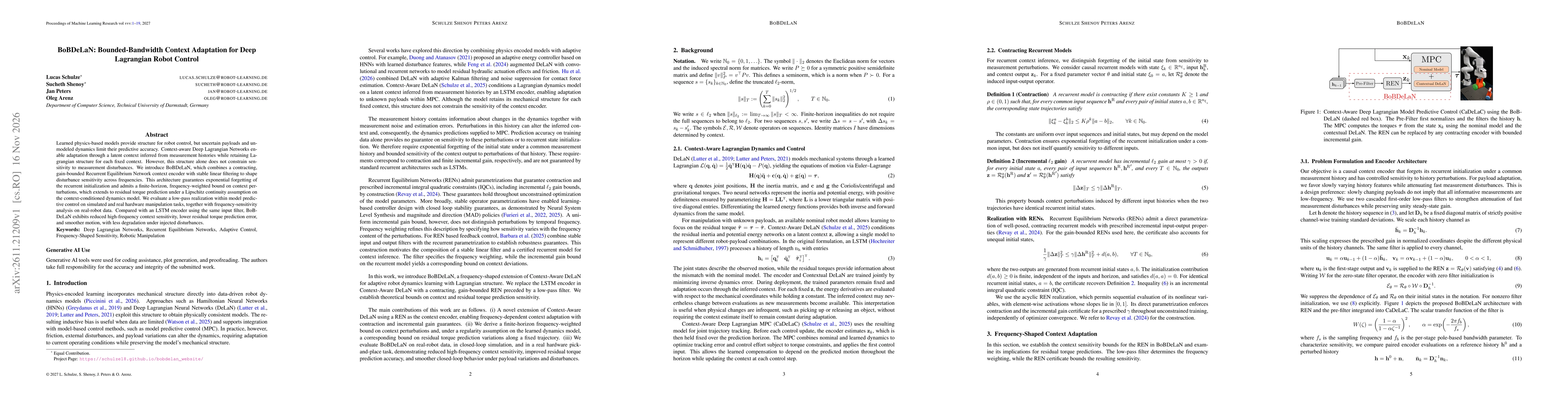
The authors replace the LSTM context encoder in a Context‑Aware Deep Lagrangian Network with a contracting, gain‑bounded Recurrent Equilibrium Network (REN) preceded by a low‑pass linear filter. They derive exponential forgetting and finite‑horizon, frequency‑weighted bounds on context perturbations and on residual torque predictions under a Lipschitz continuity assumption. The approach is evaluated within model predictive control on simulated manipulation tasks (600 runs) and on a real‑robot pick‑and‑place task, including experiments with injected sinusoidal disturbances.
SignificanceWhy the work matters
By guaranteeing bounded‑bandwidth sensitivity and exponential forgetting, BoBDeLaN enables more reliable adaptive robot control under uncertain payloads and measurement disturbances, advancing the safety and performance of learning‑based model predictive control.
Technical contributionsWhat the work introduces
Integration of a contracting, gain‑bounded REN with a stable linear low‑pass filter to shape disturbance sensitivity, together with derived exponential forgetting and frequency‑weighted bounds on context and residual torque perturbations.
NoveltyHow it differs from prior work
First work to combine a REN‑based context encoder with frequency‑shaped linear filtering in Deep Lagrangian Networks, providing provable bounded‑bandwidth adaptation for robot control.
Discussion 0