BriConstrain: Geometrically Constrained Decoding for Autoregressive Brick Assembly Generation
Abstract
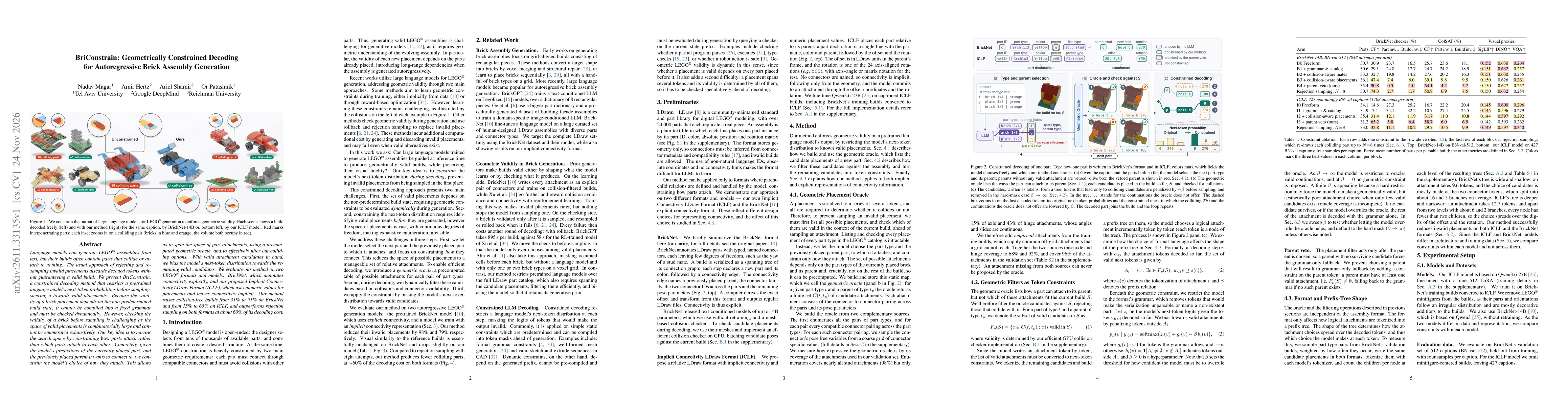
Language models can generate LEGO$^\circledR$ assemblies from text, but their builds often contain parts that collide or attach to nothing. The usual approach of rejecting and resampling invalid placements discards decoded tokens without guaranteeing a valid build. We present BriConstrain, a constrained decoding method that restricts a pretrained language model's next-token probabilities before sampling, steering it towards valid placements. Because the validity of a brick placement depends on the non-predetermined build state, it cannot be compiled into a fixed grammar and must be checked dynamically. However, checking the validity of a brick before sampling is challenging as the space of valid placements is combinatorially large and cannot be enumerated exhaustively. Our key idea is to narrow the search space by constraining how parts attach rather than which parts attach to each other. Concretely, given the model's predictions of the currently placed part, and the previously placed parent it wants to connect to, we constrain the model's choice of how they attach. This allows us to span the space of part attachments, using a precomputed geometric oracle, and to effectively filter out colliding options. With valid attachment candidates in hand, we bias the model's next-token distribution towards the remaining valid candidates. We evaluate our method on two LEGO$^\circledR$ formats and models: BrickNet, which annotates connectivity explicitly, and our proposed Implicit Connectivity LDraw Format (ICLF), which uses numeric values for placements and leaves connectivity implicit. Our method raises collision-free builds from 31% to 91% on BrickNet and from 15% to 65% on ICLF, and outperforms rejection sampling on both formats at about 60% of its decoding cost.
Analysis
AI-generated · verify against the original paper
Generated Jan 1, 0001ResultsWhat the authors found
- Collision-free builds increase from 31% to 91% on BrickNet and from 15% to 65% on the Implicit Connectivity LDraw Format.
- The method reduces invalid placements by 98% for BrickNet and 79% for the ICLF model.
- It outperforms rejection sampling while using only about 60% of the decoding cost.
MethodologyHow the work was done
BriConstrain constrains a pretrained language model's next-token probabilities by using a precomputed geometric oracle to filter valid attachment candidates during decoding, biasing the distribution toward geometrically valid placements.
SignificanceWhy the work matters
The approach enables autoregressive LEGO assembly generation that respects geometric constraints without costly resampling, improving validity and efficiency of generated designs.
Technical contributionsWhat the work introduces
Introduces a dynamic constrained decoding framework that leverages a geometric oracle to efficiently enumerate and mask invalid attachment options during token generation.
NoveltyHow it differs from prior work
First method to apply geometrically constrained decoding to LEGO assembly generation by constraining how parts attach rather than which parts, allowing real-time validity checks without exhaustive enumeration.
Discussion 0