Capture Point Trajectories for Reduced Knee Bend using Step Time Optimization
This research introduces a method optimizing step timing in bipedal walking to minimize knee bend, reducing high torques and unnatural motions. The approach uses a quadratic program and iterative feedback, effectively demonstrated by significantly decreasing knee bend in simulated Atlas humanoid walking, aiming for natural and efficient humanoid robot motion.
Abstract
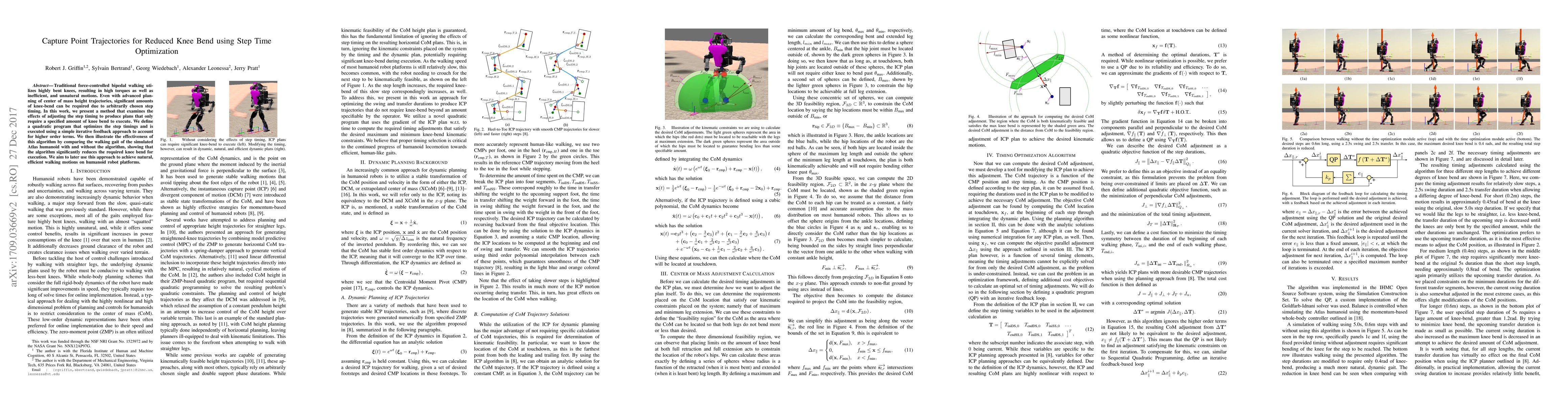
Traditional force-controlled bipedal walking utilizes highly bent knees, resulting in high torques as well as inefficient, and unnatural motions. Even with advanced planning of center of mass height trajectories, significant amounts of knee-bend can be required due to arbitrarily chosen step timing. In this work, we present a method that examines the effects of adjusting the step timing to produce plans that only require a specified amount of knee bend to execute. We define a quadratic program that optimizes the step timings and is executed using a simple iterative feedback approach to account for higher order terms. We then illustrate the effectiveness of this algorithm by comparing the walking gait of the simulated Atlas humanoid with and without the algorithm, showing that the algorithm significantly reduces the required knee bend for execution. We aim to later use this approach to achieve natural, efficient walking motions on humanoid robot platforms.
AI Key Findings
Get AI-generated insights about this paper's methodology, results, significance, and more — available when analysis has been generated.
Discussion 0