Cascaded Channel Decoupling Based Solution for RIS Regulation Matrix
This paper introduces a cascaded channel decoupling method for simplifying the regulation matrix in reconfigurable intelligent surfaces (RISs), breaking down the wave regulation into virtual receiving and transmission processes. The proposed scheme is shown to be effective and low-complexity through simulations in both single-user and multi-user access scenarios.
Abstract
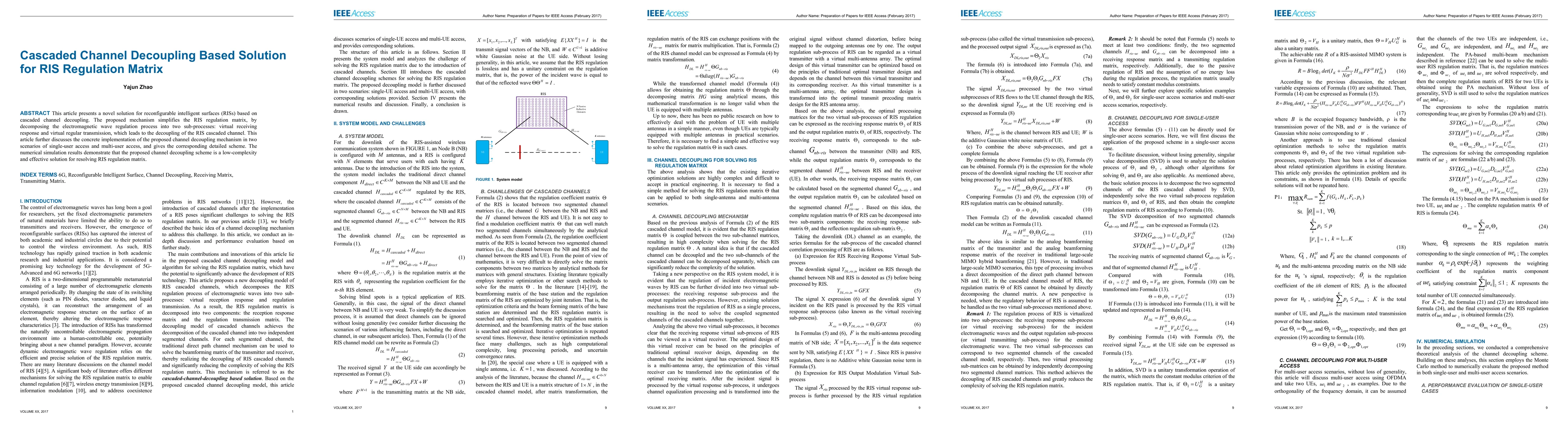
This article presents a novel solution for reconfigurable intelligent surfaces (RISs) based on cascaded channel decoupling. The proposed mechanism simplifies the RIS regulation matrix, by decomposing the electromagnetic wave regulation process into two sub-processes: virtual receiving response and virtual regular transmission, which leads to the decoupling of the RIS cascaded channel. This article further discusses the concrete implementation of the proposed channel decoupling mechanism in two scenarios of single-user access and multi-user access, and gives the corresponding detailed scheme. The numerical simulation results demonstrate that the proposed channel decoupling scheme is a low-complexity and effective solution for resolving the RIS regulation matrix.
Analysis
AI-generated · verify against the original paper
Generated Sep 6, 2025ResultsWhat the authors found
- Decomposition simplifies the calculation of the RIS regulation matrix
- Two independent channels can be solved using the cascaded decoupling mechanism
- The proposed method is a low-complexity solution for solving segmented channels
LimitationsWhere the findings need caution
- Assumes a specific RIS model and may not be applicable to all scenarios
- May require additional computational resources for large-scale systems
MethodologyHow the work was done
The proposed channel decoupling mechanism decomposes the electromagnetic wave regulation process into two sub-processes: virtual receiving response and virtual regular transmission.
SignificanceWhy the work matters
The proposed channel decoupling mechanism has significant implications for 6G wireless communication systems, enabling efficient and effective regulation of electromagnetic waves.
Technical contributionsWhat the work introduces
The proposed cascaded decoupling mechanism provides a novel approach to solving segmented channels, which is a significant technical contribution to the field of 6G wireless communication systems.
NoveltyHow it differs from prior work
The proposed method differs from existing research by decomposing the electromagnetic wave regulation process into two sub-processes, enabling efficient and effective regulation of electromagnetic waves in 6G wireless communication systems
Future workQuestions that remain
- Investigating the implementation and performance evaluation of different sub-control matrix methods
- Developing more advanced RIS models that can accommodate cascading and direct channel components simultaneously
Discussion 0