CLASS Angular Power Spectra and Map-Component Analysis for 40 GHz Observations through 2022
This paper presents an analysis of 40 GHz CMB polarization data from the CLASS survey, achieving higher sensitivity than satellite measurements. The study measures the $EE$ and $BB$ spectra of synchrotron radiation and sets a new upper limit on circular polarization, establishing a new standard for ground-based CMB polarization observations.
Abstract
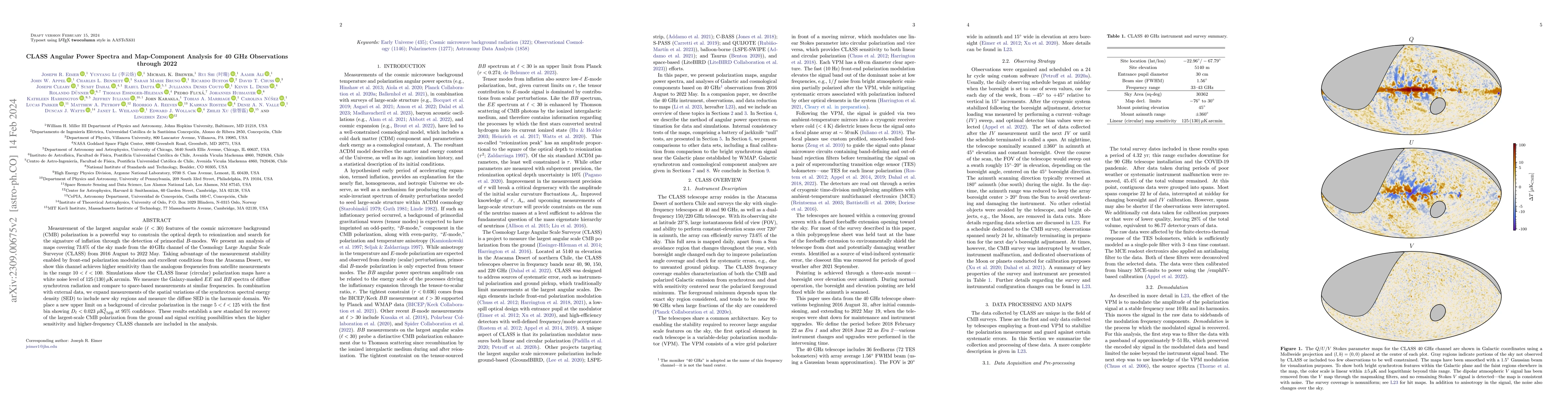
Measurement of the largest angular scale ($\ell < 30$) features of the cosmic microwave background (CMB) polarization is a powerful way to constrain the optical depth to reionization and search for the signature of inflation through the detection of primordial $B$-modes. We present an analysis of maps covering 73.6\% of the sky made from the $40\,\mathrm{GHz}$ channel of the Cosmology Large Angular Scale Surveyor (CLASS) from 2016 August to 2022 May. Taking advantage of the measurement stability enabled by front-end polarization modulation and excellent conditions from the Atacama Desert, we show this channel achieves higher sensitivity than the analogous frequencies from satellite measurements in the range $10 < \ell < 100$. Simulations show the CLASS linear (circular) polarization maps have a white noise level of $125 \,(130)\,\mathrm{\mu K\, arcmin}$. We measure the Galaxy-masked $EE$ and $BB$ spectra of diffuse synchrotron radiation and compare to space-based measurements at similar frequencies. In combination with external data, we expand measurements of the spatial variations of the synchrotron spectral energy density (SED) to include new sky regions and measure the diffuse SED in the harmonic domain. We place a new upper limit on a background of circular polarization in the range $5 < \ell < 125$ with the first bin showing $D_\ell < 0.023$ $\mathrm{\mu K^2_{CMB}}$ at 95\% confidence. These results establish a new standard for recovery of the largest-scale CMB polarization from the ground and signal exciting possibilities when the higher sensitivity and higher-frequency CLASS channels are included in the analysis.
AI Key Findings
Get AI-generated insights about this paper's methodology, results, significance, and more — available when analysis has been generated.
Discussion 0