Classical Physics: Spacetime and Fields
This paper provides a comprehensive introduction to classical physics, emphasizing the principles of general covariance and least action. It explores spacetime through general covariance, tensors, and curvature, followed by a detailed examination of fields, including gravitational and electromagnetic fields, and their symmetries and conservation laws.
Abstract
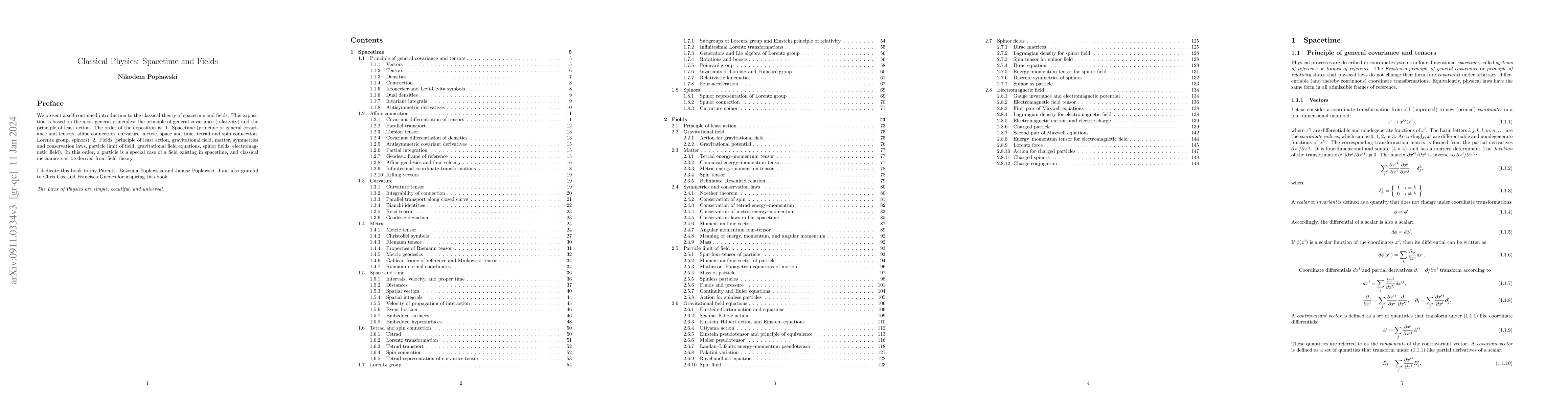
We present a self-contained introduction to the classical theory of spacetime and fields. This exposition is based on the most general principles: the principle of general covariance (relativity) and the principle of least action. The order of the exposition is: 1. Spacetime (principle of general covariance and tensors, affine connection, curvature, metric, space and time, tetrad and spin connection, Lorentz group, spinors); 2. Fields (principle of least action, gravitational field, matter, symmetries and conservation laws, particle limit of field, gravitational field equations, spinor fields, electromagnetic field). In this order, a particle is a special case of a field existing in spacetime, and classical mechanics can be derived from field theory.
AI Key Findings
Get AI-generated insights about this paper's methodology, results, significance, and more — available when analysis has been generated.
Discussion 0