This paper explores a new statistical ensemble that blends classical and quantum satisfiability problems, specifically focusing on the 2-SAT/2-QSAT problem. It identifies the precise boundary separating satisfiable (SAT) and unsatisfiable (UNSAT) instances within this ensemble, establishing coincident lower and upper bounds for large instances.
Abstract
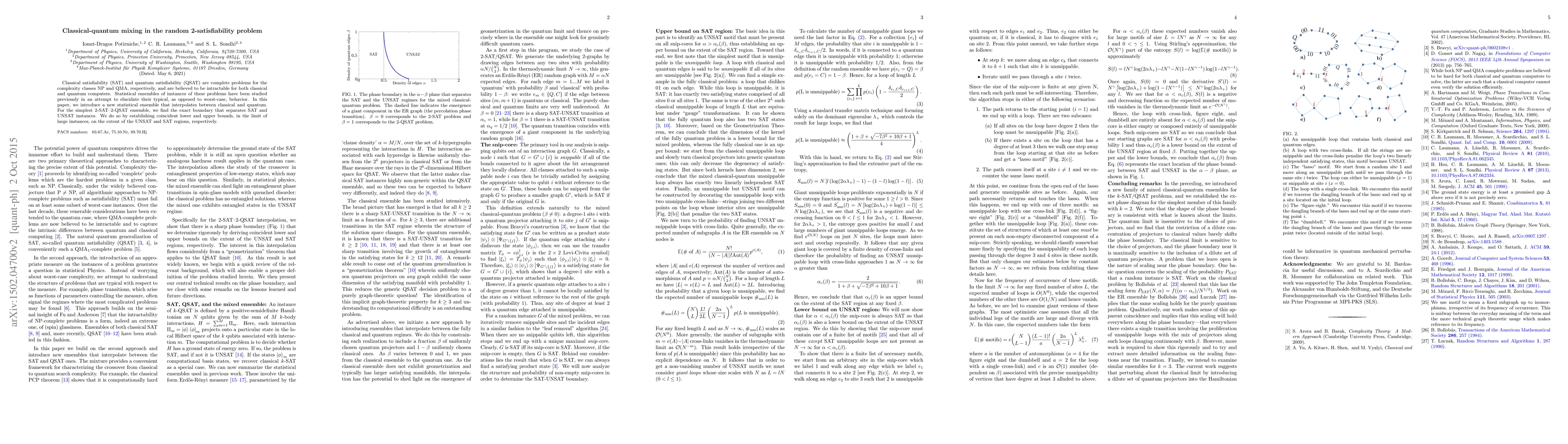
Classical satisfiability (SAT) and quantum satisfiability (QSAT) are complete problems for the complexity classes NP and QMA which are believed to be intractable for classical and quantum computers, respectively. Statistical ensembles of instances of these problems have been studied previously in an attempt to elucidate their typical, as opposed to worst case, behavior. In this paper we introduce a new statistical ensemble that interpolates between classical and quantum. For the simplest 2-SAT/2-QSAT ensemble we find the exact boundary that separates SAT and UNSAT instances. We do so by establishing coincident lower and upper bounds, in the limit of large instances, on the extent of the UNSAT and SAT regions, respectively.
AI Key Findings
Get AI-generated insights about this paper's methodology, results, significance, and more — available when analysis has been generated.
Discussion 0