ClothCast: Generative Cloth World Modeling under Partial Observability
Abstract
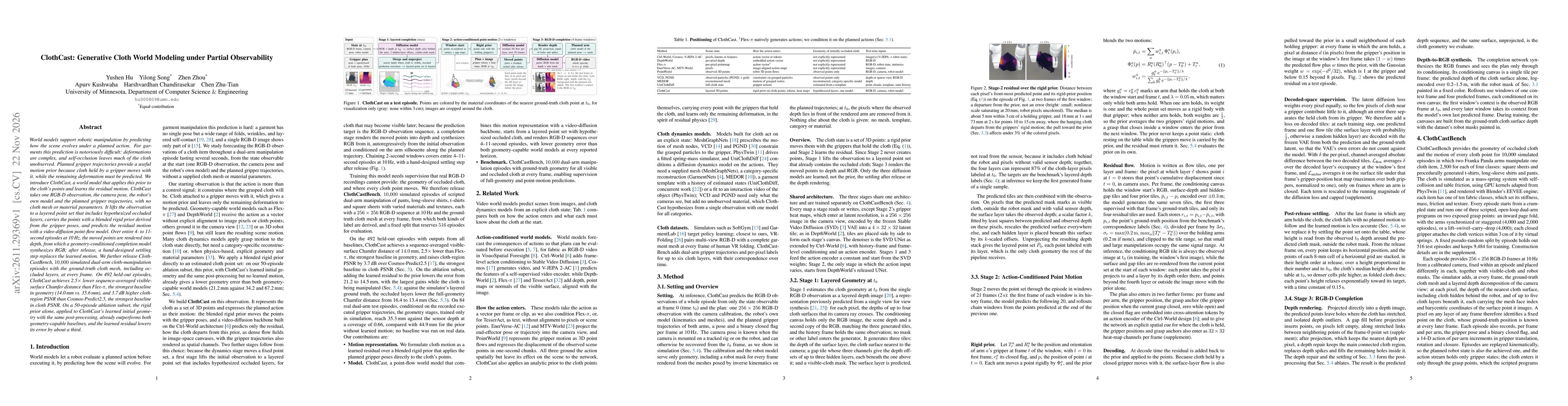
World models support robotic manipulation by predicting how the scene evolves under a planned action. For garments this prediction is notoriously difficult: deformations are complex, and self-occlusion leaves much of the cloth unobserved. Planned gripper trajectories provide a useful motion prior because cloth held by a gripper moves with it, while the remaining deformation must be predicted. We introduce ClothCast, a world model that applies this prior to the cloth's points and learns the residual motion. ClothCast takes one RGB-D observation, the camera pose, the robot's own model and the planned gripper trajectories, with no cloth mesh or material parameters. It lifts the observation to a layered point set that includes hypothesized occluded layers, carries the points with a blended rigid prior derived from the gripper poses, and predicts the residual motion with a video-diffusion point-flow model. Over entire 4- to 11-second episodes at 10 Hz, the moved points are rendered into depth, from which a geometry-conditioned completion model synthesizes RGB; after release, a hand-designed settling step replaces the learned motion. We further release ClothCastBench, 10,000 simulated dual-arm cloth-manipulation episodes with the ground-truth cloth mesh, including occluded layers, at every frame. On 492 held-out episodes, ClothCast achieves 2.5x lower sequence-averaged visible-surface Chamfer distance than Flex-π, the strongest baseline in geometry (14.0 mm vs. 35.6 mm), and 3.7 dB higher cloth-region PSNR than Cosmos-Predict2.5, the strongest baseline in cloth PSNR. On a 50-episode ablation subset, the rigid prior alone, applied to ClothCast's learned initial geometry with the same post-processing, already outperforms both geometry-capable baselines, and the learned residual lowers its error by about a third.
AI Key Findings
Get AI-generated insights about this paper's methodology, results, significance, and more — available when analysis has been generated.
Discussion 0