Combinatorial Hodge Index Theorem for Polytopes
The paper extends the Maxim–Schuermann intersection cohomology results from rational polytopes to arbitrary convex polytopes using the BBFK combinatorial framework, showing a generalized intersection cohomology signature for toric-like objects. It also discusses a polytope version of the Hodge index theorem, linking combinatorial data to geometric invariants beyond rational polytopes.
Abstract
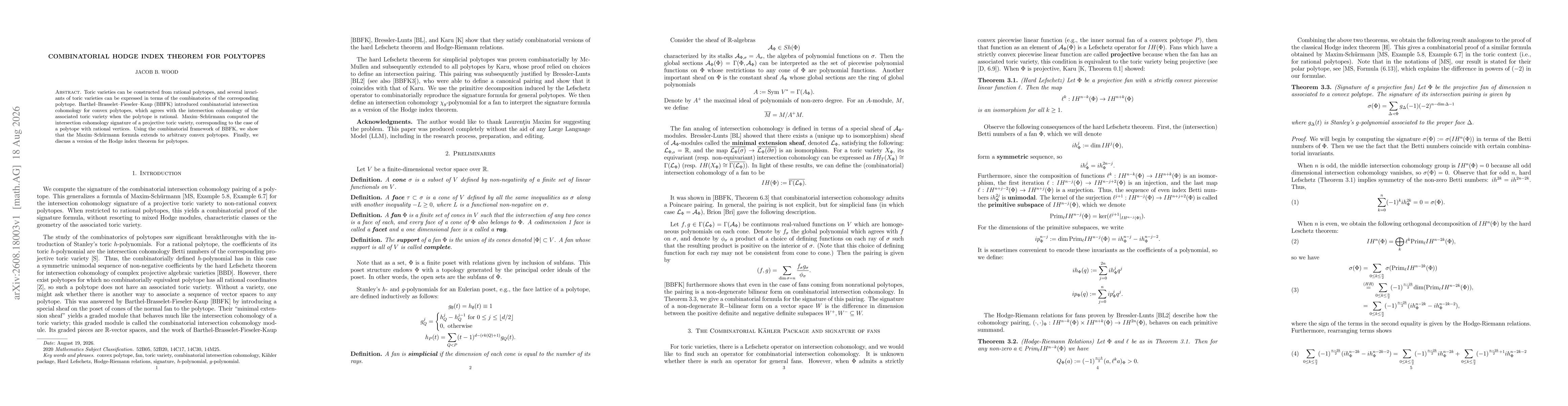
Toric varieties can be constructed from rational polytopes, and several invariants of toric varieties can be expressed in terms of the combinatorics of the corresponding polytope. Barthel-Brasselet-Fieseler-Kaup (BBFK) introduced combinatorial intersection cohomology for convex polytopes, which agrees with the intersection cohomology of the associated toric variety when the polytope is rational. Maxim-Schuermann computed the intersection cohomology signature of a projective toric variety, corresponding to the case of a polytope with rational vertices. Using the combinatorial framework of BBFK, we show that the Maxim-Schuermann formula extends to arbitrary convex polytopes. Finally, we discuss a version of the Hodge index theorem for polytopes.
Analysis
AI-generated · verify against the original paper
Generated Aug 20, 2026ResultsWhat the authors found
- A combinatorial interpretation of the intersection cohomology signature extends from rational to arbitrary convex polytopes using the BBFK framework.
- Definition of an IHχy-polynomial for fans associated with polytopes provides a combinatorial version of the Hodge index theorem.
- The generalized signature σ(Φ) for a polytope’s associated fan Φ matches the χIH1(Φ) value, aligning with classical projective toric geometry in the rational case and extending beyond it.
- The results unify signatures of toric varieties and combinatorial intersection cohomology through a purely combinatorial construction.
LimitationsWhere the findings need caution
- The construction relies on the BBFK combinatorial framework, which may have technical prerequisites that limit direct computation for certain complex polytope fans.
- Computational complexity of the IHχy-polynomial for large or highly non-rational polytopes is not addressed in detail.
MethodologyHow the work was done
The study builds on the BBFK framework of combinatorial intersection cohomology for convex polytopes and utilizes the primitive decomposition from Lefschetz theory to translate the signature formula from rational polytopes to arbitrary convex polytopes. It then defines an IHχy-polynomial via the BBFK setup to reinterpret the Hodge index theorem combinatorially, culminating in a generalized signature formula for non-rational polytopes.
SignificanceWhy the work matters
This work broadens the applicability of the Hodge index theorem and signature formulas to non-rational polytopes, offering a purely combinatorial path to understanding intersection-theoretic invariants beyond toric variety constraints.
Technical contributionsWhat the work introduces
Introduction of an intersection cohomology χy-polynomial for fans of polytopes within the BBFK framework, enabling a combinatorial reinterpretation of the Hodge index theorem and a generalized signature formula for arbitrary convex polytopes.
NoveltyHow it differs from prior work
Extends the Maxim–Schürmann signature formula from rational polytopes to all convex polytopes using purely combinatorial intersection cohomology, providing a new combinatorial Hodge-type result for non-rational polytopes.
Future workQuestions that remain
- Develop efficient algorithms to compute IHχy-polynomials for broad classes of non-rational polytopes.
- Explore connections with other combinatorial invariants and potential geometric realizations beyond toric settings.
- Investigate potential generalizations to broader classes of fans or to non-convex polytope configurations.
Discussion 0