Controlling Proactive Multimodal AI: Separating Perception from Participation
Abstract
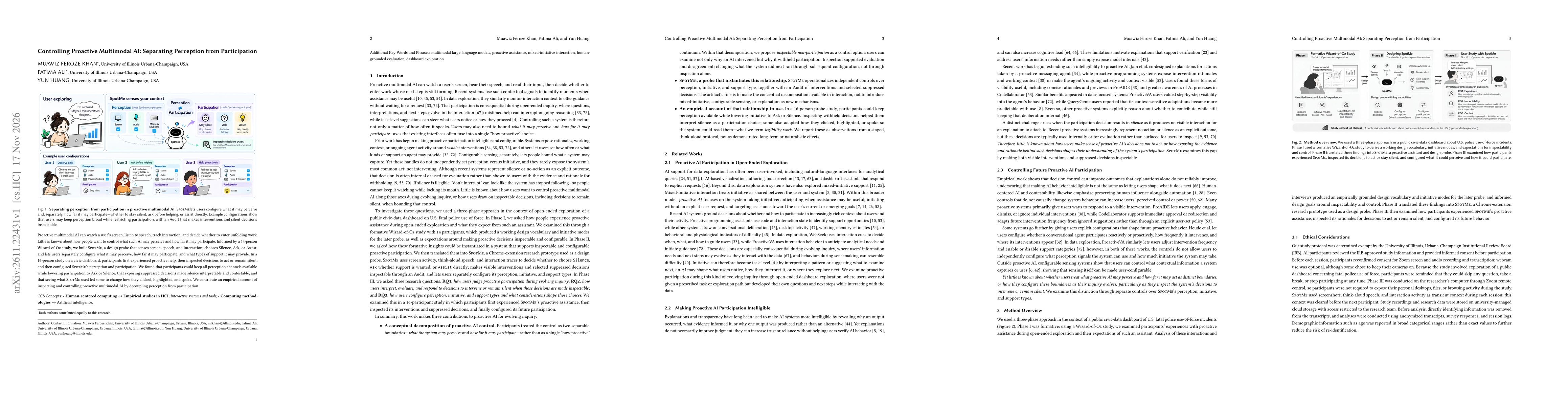
Proactive multimodal AI can watch a user's screen, listen to speech, track interaction, and decide whether to enter unfolding work. Little is known about how people want to control what such AI may perceive and how far it may participate. Informed by a 14-person Wizard-of-Oz study, we built SpotMe, a design probe that senses screen, speech, and interaction; chooses Silence, Ask, or Assist; and lets users separately configure what it may perceive, how far it may participate, and what types of support it may provide. In a 16-person study on a civic dashboard, participants first experienced proactive help, then inspected decisions to act or remain silent, and then configured SpotMe's perception and participation. We found that participants could keep all perception channels available while lowering participation to Ask or Silence; that exposing suppressed decisions made silence interpretable and contestable; and that seeing what SpotMe used led some to change how they clicked, highlighted, and spoke. We contribute an empirical account of inspecting and controlling proactive multimodal AI by decoupling perception from participation.
Analysis
AI-generated · verify against the original paper
Generated Jan 1, 0001ResultsWhat the authors found
- Participants were able to keep all perception channels active while lowering participation to Ask or Silence.
- Exposing suppressed decisions made silent behavior interpretable and contestable to users.
- Seeing what SpotMe used as input caused some participants to change how they clicked, highlighted, and spoke.
LimitationsWhere the findings need caution
- The study was limited to a single domain (a civic dashboard) and a small sample size (16 participants).
- SpotMe was a research prototype with limited real‑world robustness and only three participation modes (Silence, Ask, Assist).
MethodologyHow the work was done
The authors conducted a three‑phase mixed‑methods study: Phase I was a formative 14‑person Wizard‑of‑Oz study to gather design insights; Phase II involved building SpotMe, a Chrome‑extension design probe that senses screen, speech, and interaction and offers configurable perception and participation modes; Phase III was a 16‑person user study on a civic dashboard where participants experienced proactive help, inspected the system’s decisions (including suppressed ones), and configured SpotMe’s perception and participation settings.
SignificanceWhy the work matters
The work provides an empirical account of how users can inspect and control proactive multimodal AI by decoupling what the system may perceive from how far it may participate, addressing a gap in user control over AI perception and initiative.
Technical contributionsWhat the work introduces
SpotMe, a design probe that separately configures perception channels (screen, speech, interaction) and participation levels (Silence, Ask, Assist), and provides an audit interface exposing suppressed decisions for user inspection.
NoveltyHow it differs from prior work
The paper introduces a conceptual decomposition of proactive AI control into two independent dimensions—perception and participation—allowing users to keep sensing capabilities while restricting initiative, a separation not previously addressed in proactive multimodal systems.
Future workQuestions that remain
- Explore the approach in broader application contexts and with larger, more diverse user populations.
- Investigate richer configuration options and finer‑grained perception controls beyond the three channels used.
Discussion 0