Cross-lingual Text Classification with Heterogeneous Graph Neural Network
This paper proposes a graph neural network approach for cross-lingual text classification that incorporates heterogeneous information such as part-of-speech roles and semantic similarity. The method outperforms state-of-the-art models and shows consistent gains in low-resource language settings.
Abstract
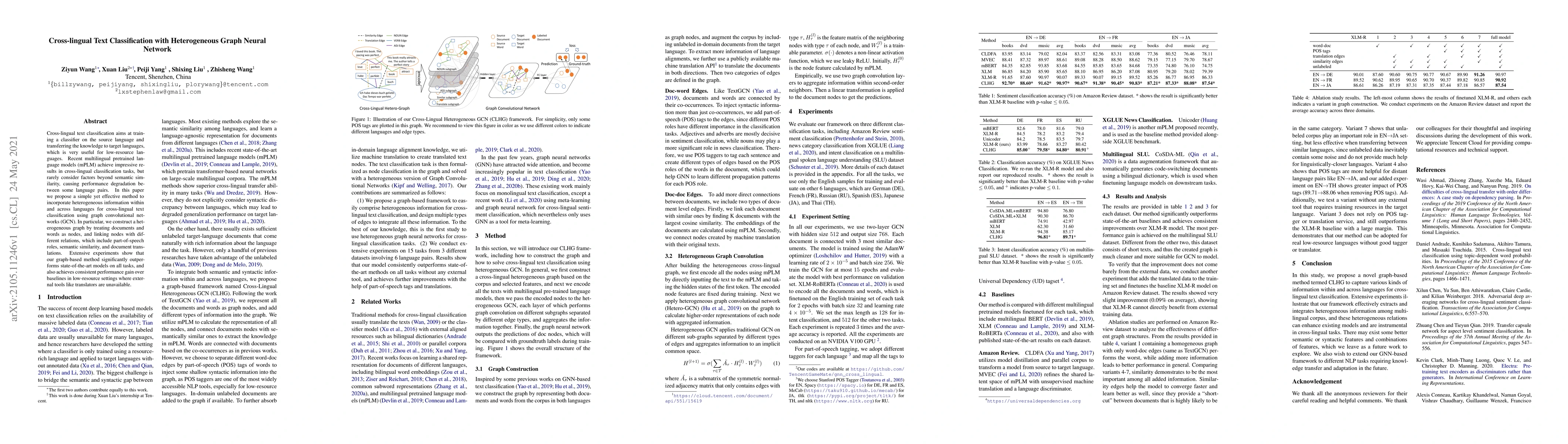
Cross-lingual text classification aims at training a classifier on the source language and transferring the knowledge to target languages, which is very useful for low-resource languages. Recent multilingual pretrained language models (mPLM) achieve impressive results in cross-lingual classification tasks, but rarely consider factors beyond semantic similarity, causing performance degradation between some language pairs. In this paper we propose a simple yet effective method to incorporate heterogeneous information within and across languages for cross-lingual text classification using graph convolutional networks (GCN). In particular, we construct a heterogeneous graph by treating documents and words as nodes, and linking nodes with different relations, which include part-of-speech roles, semantic similarity, and document translations. Extensive experiments show that our graph-based method significantly outperforms state-of-the-art models on all tasks, and also achieves consistent performance gain over baselines in low-resource settings where external tools like translators are unavailable.
AI Key Findings
Get AI-generated insights about this paper's methodology, results, significance, and more — available when analysis has been generated.
Discussion 0