Cyber-Physical RSI for AI-RAN: A Case Study
Abstract
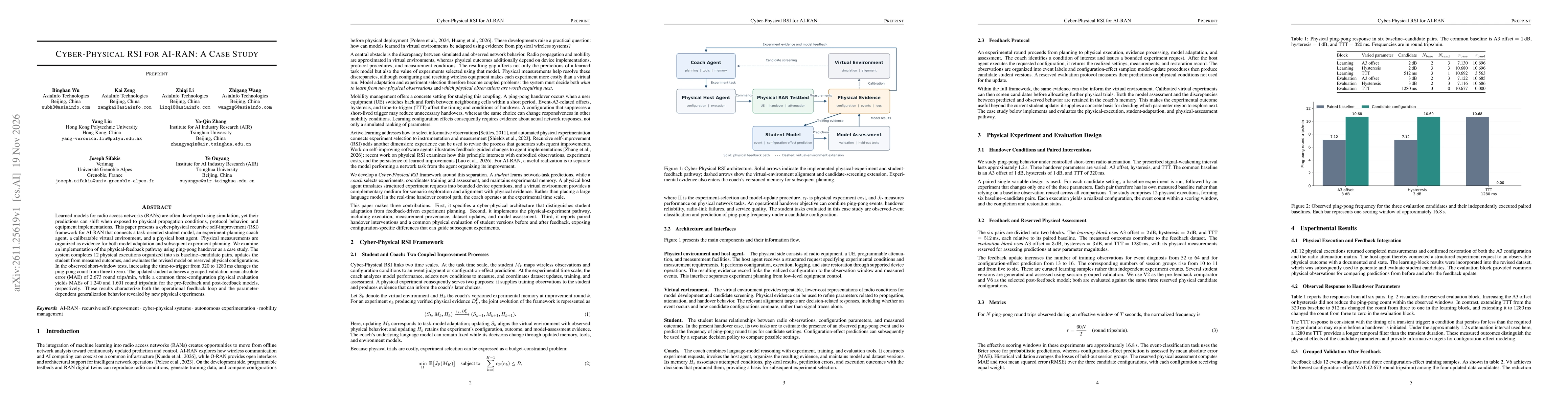
Learned models for radio access networks (RANs) are often developed using simulation, yet their predictions can shift when exposed to physical propagation conditions, protocol behavior, and equipment implementations. This paper presents a cyber-physical recursive self-improvement (RSI) framework for AI-RAN that connects a task-oriented student model, an experiment-planning coach agent, a calibratable virtual environment, and a physical host agent. Physical measurements are organized as evidence for both model adaptation and subsequent experiment planning. We examine an implementation of the physical-feedback pathway using ping-pong handover as a case study. The system completes 12 physical executions organized into six baseline--candidate pairs, updates the student from measured outcomes, and evaluates the revised model on reserved physical configurations. In the observed short-window tests, increasing the time-to-trigger from 320 to 1280\,ms changes the ping-pong count from three to zero. The updated student achieves a grouped-validation mean absolute error (MAE) of 2.673 round trips/min, while a common three-configuration physical evaluation yields MAEs of 1.240 and 1.601 round trips/min for the pre-feedback and post-feedback models, respectively. These results characterize both the operational feedback loop and the parameter-dependent generalization behavior revealed by new physical experiments.
Analysis
AI-generated · verify against the original paper
Generated Jan 1, 0001ResultsWhat the authors found
- Increasing the time‑to‑trigger (TTT) from 320 ms to 1280 ms reduced the ping‑pong handover count from three to zero in short‑window tests.
- The updated student model achieved a grouped‑validation mean absolute error (MAE) of 2.673 round trips/min.
- Physical evaluation yielded MAEs of 1.240 (pre‑feedback) and 1.601 (post‑feedback) round trips/min for the respective models.
- Configuration‑dependent prediction errors were observed on new physical settings, highlighting parameter‑specific generalization behavior.
LimitationsWhere the findings need caution
- Experiments were limited to short‑window tests and a single handover scenario.
- Only six baseline‑candidate pairs (12 executions) were conducted, restricting statistical robustness.
- Physical trials are costly, limiting the breadth of parameter exploration.
MethodologyHow the work was done
The paper proposes a cyber‑physical recursive self‑improvement (RSI) framework for AI‑RAN that couples a task‑oriented student model, an experiment‑planning coach agent, a calibratable virtual environment, and a physical host agent. Physical measurements are used as evidence for both model adaptation and subsequent experiment planning. The implementation is demonstrated on a ping‑pong handover case study with 12 physical executions organized into six baseline‑candidate pairs, followed by student model updates and evaluation on reserved physical configurations.
SignificanceWhy the work matters
The study demonstrates that integrating physical feedback into AI‑RAN model training can close the simulation‑reality gap, enabling more accurate predictions and informed experiment selection, which is crucial for autonomous network operation.
Technical contributionsWhat the work introduces
A novel cyber‑physical architecture that separates student model adaptation from coach‑driven experiment planning, together with an implemented physical‑feedback pathway that updates the model using real‑world measurements and evaluates its impact on reserved configurations.
NoveltyHow it differs from prior work
First work to combine recursive self‑improvement with a cyber‑physical loop for AI‑RAN, linking virtual twin simulations and physical host agents to iteratively refine network models based on real‑world evidence.
Future workQuestions that remain
- Extend the framework to broader mobility conditions and additional RAN parameters.
- Scale up the number of physical experiments and testbeds to improve statistical confidence.
- Investigate long‑term adaptation and richer network‑level objectives beyond handover counts.
Discussion 0