DAQ: Decision-Aligned Post-Training Quantization for Spiking Transformers
Abstract
Spiking transformers combine attention-based representation learning with sparse spike communication, yet their weights and membrane variables still incur substantial storage and computation overhead. Post-training quantization (PTQ) offers a practical way to reduce these overheads, but preserving neuronal firing under weight and membrane quantization remains challenging. In this paper, we propose Decision-Aligned Post-Training Quantization (DAQ), a method that calibrates the quantizers to align neuronal firing decisions with those of a floating-point reference. We analyze how errors from these quantizers affect firing at decision boundaries and how they propagate over time steps in recurrent neurons. Based on this analysis, we formulate an objective that encourages quantized membrane variables to remain within the reference firing regions along the quantized model's own state trajectory. Experiments across multiple spiking transformer architectures on image classification, semantic segmentation, and event-based tracking demonstrate the effectiveness of DAQ with 4-bit weights and membrane variables. On FE108, DAQ achieves 58.8\% AUC and 90.9\% PR with SDTrack, while reducing energy by 66.2\%.
Analysis
AI-generated · verify against the original paper
Generated Jan 1, 0001ResultsWhat the authors found
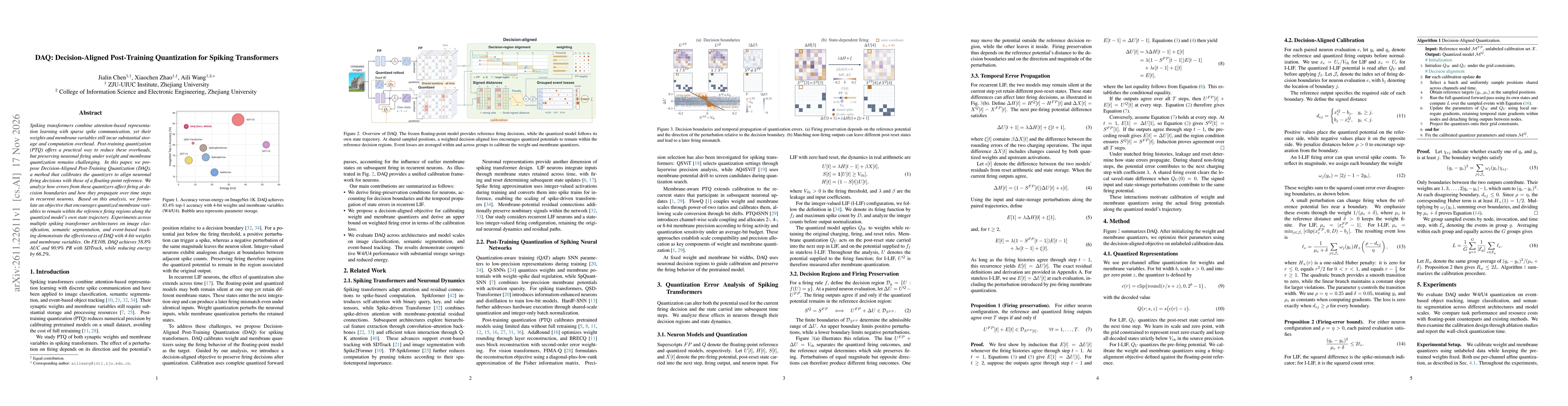
- DAQ with 4‑bit weights and membrane variables achieves 83.4% top‑1 accuracy on ImageNet‑1K.
- On the FE108 dataset, DAQ attains 58.8% AUC and 90.9% PR for event‑based tracking (SDTrack).
- DAQ reduces energy consumption by 66.2% compared to the full‑precision baseline.
MethodologyHow the work was done
Decision-Aligned Post-Training Quantization (DAQ) calibrates weight and membrane quantizers by aligning the quantized model's neuronal firing decisions with those of a floating‑point reference, using a decision‑aligned loss that encourages quantized membrane potentials to stay within the reference firing regions along the model's own state trajectory.
SignificanceWhy the work matters
By preserving neuronal firing decisions after quantization, DAQ enables substantial storage and energy savings for spiking transformers while maintaining competitive performance across classification, segmentation, and tracking tasks.
Technical contributionsWhat the work introduces
Introduces a decision‑aligned calibration objective that quantifies and minimizes firing‑region violations, and derives an upper bound on weighted firing error to guide quantizer calibration.
NoveltyHow it differs from prior work
First PTQ method for spiking transformers that explicitly aligns quantized membrane dynamics with floating‑point firing boundaries and accounts for temporal error propagation in recurrent LIF neurons.
Discussion 0