DATT: Deep Adaptive Trajectory Tracking for Quadrotor Control
The research paper presents DATT, a Deep Adaptive Trajectory Tracking method for quadrotor control that leverages reinforcement learning and adaptive control to precisely follow complex, potentially infeasible trajectories under large disturbances, outperforming traditional adaptive controllers. DATT operates efficiently with online inference times under 3.2 ms.
Abstract
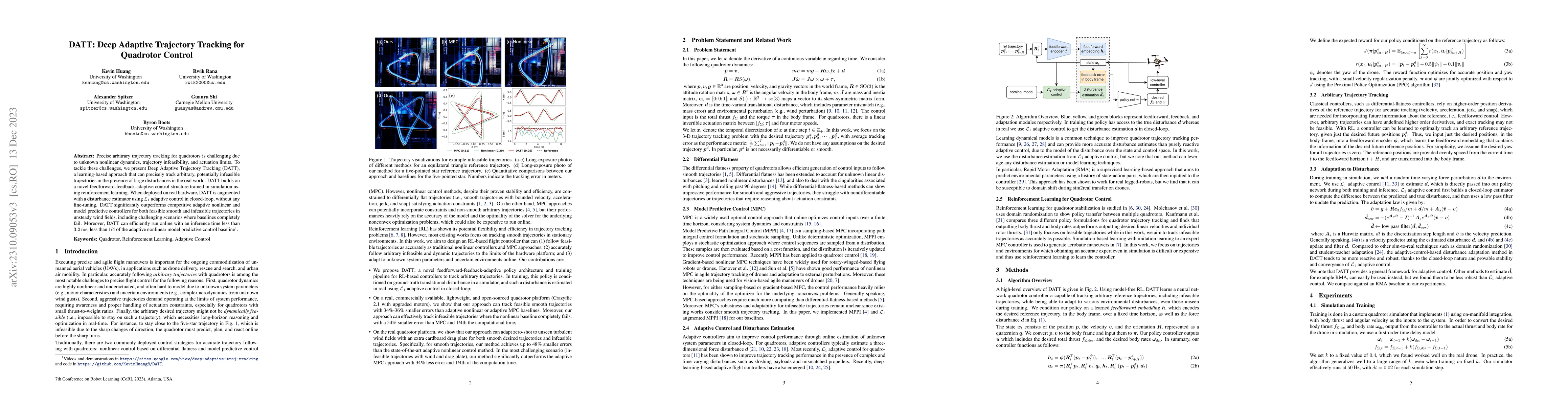
Precise arbitrary trajectory tracking for quadrotors is challenging due to unknown nonlinear dynamics, trajectory infeasibility, and actuation limits. To tackle these challenges, we present Deep Adaptive Trajectory Tracking (DATT), a learning-based approach that can precisely track arbitrary, potentially infeasible trajectories in the presence of large disturbances in the real world. DATT builds on a novel feedforward-feedback-adaptive control structure trained in simulation using reinforcement learning. When deployed on real hardware, DATT is augmented with a disturbance estimator using L1 adaptive control in closed-loop, without any fine-tuning. DATT significantly outperforms competitive adaptive nonlinear and model predictive controllers for both feasible smooth and infeasible trajectories in unsteady wind fields, including challenging scenarios where baselines completely fail. Moreover, DATT can efficiently run online with an inference time less than 3.2 ms, less than 1/4 of the adaptive nonlinear model predictive control baseline
AI Key Findings
Get AI-generated insights about this paper's methodology, results, significance, and more — available when analysis has been generated.
Discussion 0