Déjà VAE: When Do Autoencoder Traces Reveal Generated Images?
Abstract
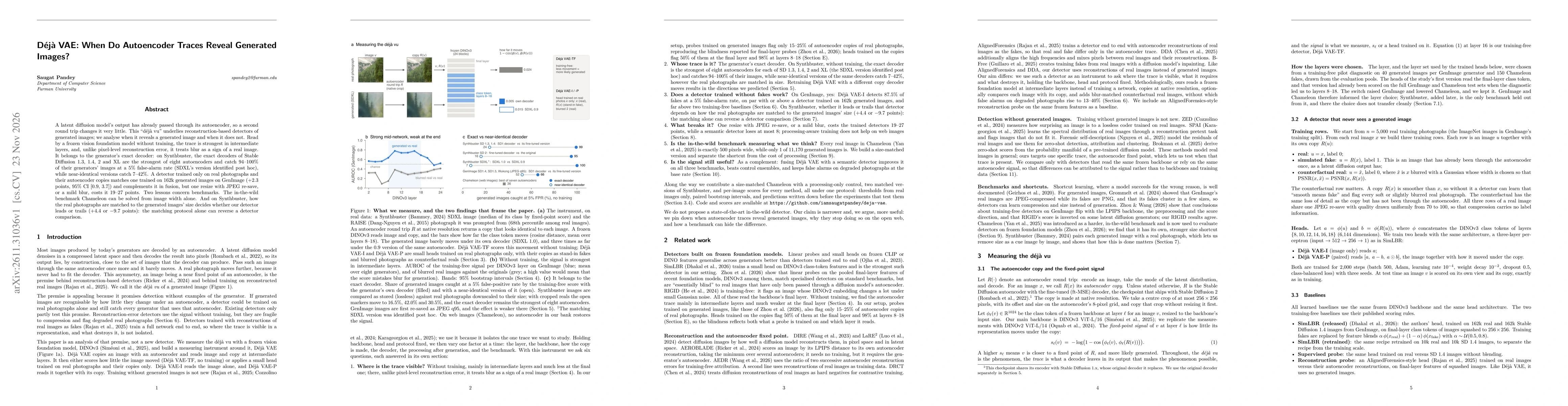
A latent diffusion model's output has already passed through its autoencoder, so a second round trip changes it very little. This "déjà vu" underlies reconstruction-based detectors of generated images; we analyse when it reveals a generated image and when it does not. Read by a frozen vision foundation model without training, the trace is strongest in intermediate layers, and, unlike pixel-level reconstruction error, it treats blur as a sign of a real image. It belongs to the generator's exact decoder: on Synthbuster, the exact decoders of Stable Diffusion 1.3, 1.4, 2 and XL are the strongest of eight autoencoders and catch 94-100% of their generators' images at a 5% false-alarm rate (SDXL's version identified post hoc), while near-identical versions catch 7-42%. A detector trained only on real photographs and their autoencoder copies matches one trained on 162k generated images on GenImage (+2.3 points, 95% CI [0.9, 3.7]) and complements it in fusion, but one resize with JPEG re-save, or a mild blur, costs it 19-27 points. Two lessons concern benchmarks. The in-the-wild benchmark Chameleon can be solved from image width alone. And on Synthbuster, how the real photographs are matched to the generated images' size decides whether our detector leads or trails (+4.4 or -9.7 points): the matching protocol alone can reverse a detector comparison. Code and per-image scores: https://github.com/iamsaugatpandey/deja-vae
Analysis
AI-generated · verify against the original paper
Generated Jan 1, 0001ResultsWhat the authors found
- Exact decoders of Stable Diffusion (1.3, 1.4, 2, XL) achieve the highest detection rates, catching 94–100% of generated images at 5% false‑positive rate, while near‑identical decoders catch only 7–42%.
- A detector trained solely on real photos and their autoencoder copies matches the performance of a detector trained on 162k generated images on GenImage (+2.3 points, 95% CI [0.9, 3.7]).
- One extra resize with JPEG re‑save or a mild blur degrades detection performance by 19–27 points.
- The trace is strongest in intermediate DINOv3 layers and, unlike pixel‑level reconstruction error, treats blur as indicative of real images.
LimitationsWhere the findings need caution
- Detection performance drops sharply under simple image degradations such as resizing and JPEG compression.
- The signal relies on the exact decoder; near‑identical decoders provide weak detection, limiting applicability to models without access to the original decoder.
MethodologyHow the work was done
The authors measure the autoencoder trace by passing images through their original autoencoder and a frozen vision foundation model (DINOv3) to compute cosine distance of class token embeddings across intermediate layers. They evaluate both a training-free score (DéjàVAE‑TF) and small heads trained only on real photographs and their autoencoder copies (DéjàVAE‑I/P). Experiments are conducted on benchmarks Synthbuster, GenImage, and Chameleon, varying decoders, image processing, and matching protocols.
SignificanceWhy the work matters
The study demonstrates that reconstruction‑based detection can work without any generated examples by exploiting the near‑fixed‑point property of autoencoders, and it reveals critical factors—decoder exactness, preprocessing, and benchmark matching protocols—that dramatically affect detector evaluation.
Technical contributionsWhat the work introduces
Introduces DéjàVAE, a measurement framework that quantifies autoencoder traces using frozen vision models and provides both training‑free and minimally supervised detectors for generated images.
NoveltyHow it differs from prior work
Shows that the autoencoder trace is strongest in intermediate layers of a frozen foundation model and that exact decoders uniquely enable high‑accuracy detection without any generated training data.
Future workQuestions that remain
- Investigate robustness of the autoencoder trace to more diverse image corruptions and real‑world post‑processing pipelines.
- Explore methods to recover or approximate the exact decoder for black‑box generators to improve detection coverage.
Discussion 0