DeltaRAE: Derivative Tokenization for Long Video Generation
Abstract
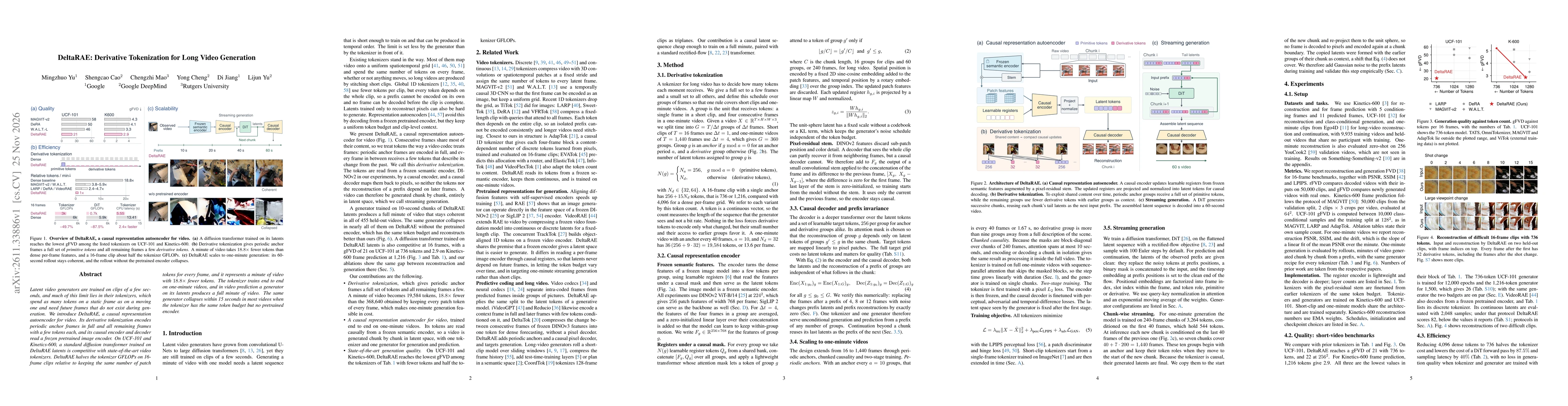
Latent video generators are trained on clips of a few seconds, and much of this limit lies in their tokenizers, which spend as many tokens on a static frame as on a moving one and need future frames that do not exist during generation. We introduce DeltaRAE, a causal representation autoencoder for video. Its derivative tokenization encodes periodic anchor frames in full and all remaining frames with a few tokens each, and its causal encoder and decoder read a frozen pretrained image encoder. On UCF-101 and Kinetics-600, a standard diffusion transformer trained on DeltaRAE latents is competitive with state-of-the-art video tokenizers. DeltaRAE halves the tokenizer GFLOPs on 16-frame clips relative to keeping the same number of patch tokens for every frame, and it represents a minute of video with 18.8x fewer tokens. The tokenizer trains end to end on one-minute videos, and in video prediction a generator on its latents produces a full minute of video. The same generator collapses within 15 seconds in most videos when the tokenizer has the same token budget but no pretrained encoder.
Analysis
AI-generated · verify against the original paper
Generated Jan 1, 0001ResultsWhat the authors found
- DeltaRAE achieves the lowest gFVD among listed tokenizers on UCF‑101 and Kinetics‑600 while using fewer tokens.
- The tokenizer reduces token count by 18.8× for a minute of video and halves the GFLOPs on 16‑frame clips compared to dense patch tokenization.
- Tokenizer GFLOPs are reduced by 49.7% and generator latency by 87.5% relative to a dense baseline.
- A diffusion transformer trained on DeltaRAE latents can generate a coherent one‑minute video, whereas the same generator collapses within 15 seconds when the pretrained encoder is removed.
LimitationsWhere the findings need caution
- The generation collapses quickly without the frozen pretrained encoder, indicating dependence on that external representation.
- The approach is evaluated primarily on 1‑minute videos; scalability to substantially longer durations remains unproven.
- Token budgets are still limited by the causal mask and memory constraints for very long sequences.
MethodologyHow the work was done
DeltaRAE is a causal representation autoencoder that uses derivative tokenization: periodic anchor frames are encoded in full while intervening frames are represented by a few derivative tokens describing changes from previous frames. The encoder and decoder read from a frozen pretrained image encoder (DI-NOv2) and operate causally, allowing chunk‑by‑chunk generation. A diffusion transformer is trained on the resulting latents for video prediction and long‑duration generation.
SignificanceWhy the work matters
By drastically lowering token budgets and computational cost, DeltaRAE makes minute‑scale video generation feasible with a single latent model, opening the way for more efficient and scalable generative video systems.
Technical contributionsWhat the work introduces
Introduces derivative tokenization combined with a causal autoencoder that reads from a frozen pretrained image encoder, enabling efficient, low‑token video representation and streaming generation.
NoveltyHow it differs from prior work
First video tokenizer to encode anchor frames fully and remaining frames with derivative tokens in a causal autoencoder architecture, achieving state‑of‑the‑art quality with substantially fewer tokens and computational resources.
Future workQuestions that remain
- Develop methods to reduce reliance on the frozen pretrained encoder and improve robustness of generation.
- Extend the derivative tokenization framework to support longer video horizons beyond one minute.
- Explore alternative pretrained encoders and adaptive token budgets for diverse motion dynamics.
Discussion 0