DEO: Training-Free Direct Embedding Optimization for Negation-Aware Retrieval
Abstract
Recent advances in Large Language Models (LLMs) and Retrieval-Augmented Generation (RAG) have enabled diverse retrieval methods. However, existing retrieval methods often fail to accurately retrieve results for negation and exclusion queries. To address this limitation, prior approaches rely on embedding adaptation or fine-tuning, which introduce additional computational cost and deployment complexity. We propose Direct Embedding Optimization (DEO), a training-free method for negation-aware text and multimodal retrieval. DEO decomposes queries into positive and negative components and optimizes the query embedding with a contrastive objective. Without additional training data or model updates, DEO outperforms baselines on NegConstraint, with gains of +0.0738 nDCG@10 and +0.1028 MAP@100, while improving Recall@5 by +6\% over OpenAI CLIP in multimodal retrieval. These results demonstrate the practicality of DEO for negation- and exclusion-aware retrieval in real-world settings.
Analysis
AI-generated · verify against the original paper
Generated Jan 1, 0001ResultsWhat the authors found
- DEO improves MAP on the NegConstraint benchmark from 0.6299 to 0.7327 and nDCG@10 from 0.7139 to 0.7877.
- DEO increases Recall@5 on the COCO‑Neg multimodal benchmark with OpenAI CLIP from 0.4792 to 0.5392 (+6%).
- Across all evaluated text retrieval benchmarks, DEO consistently outperforms baseline methods.
MethodologyHow the work was done
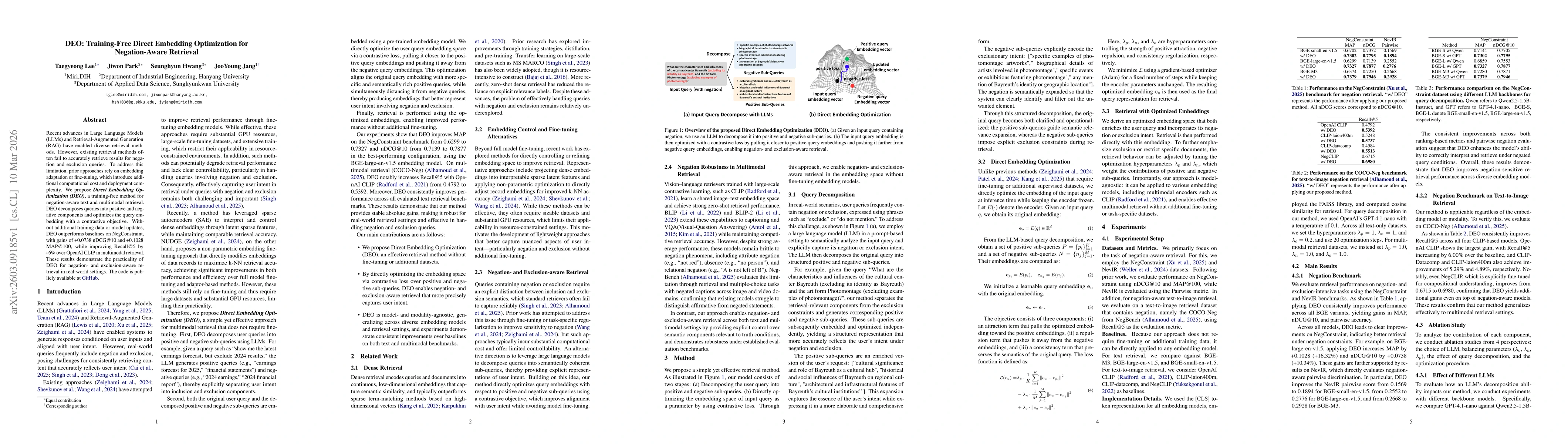
DEO first uses a large language model to decompose a user query into positive and negative sub‑queries. All sub‑queries and the original query are embedded with a pre‑trained model, then the original query embedding is directly optimized via a contrastive loss that pulls it toward the positive embeddings and pushes it away from the negative embeddings, without any fine‑tuning or additional training data.
SignificanceWhy the work matters
The method demonstrates that negation‑aware retrieval can be achieved without costly model fine‑tuning, making it practical for resource‑constrained deployments and improving real‑world search relevance for exclusion queries.
Technical contributionsWhat the work introduces
A training‑free, contrastive embedding optimization that aligns query vectors with semantically rich positive sub‑queries while distancing them from negative sub‑queries, applicable to both text and multimodal retrieval.
NoveltyHow it differs from prior work
Introducing a direct embedding optimization pipeline that leverages LLM‑generated positive/negative query decomposition and contrastive learning, eliminating the need for additional training data or model updates.
Discussion 0