Design an Algorithmic Stablecoin based on a Predictive PID Controller
Abstract
Cryptocurrencies issued based on blockchain technology have attracted increasing attention in recent years. However, their high volatility makes it difficult for them to become circulating currencies. This led to the creation of stablecoins. Existing stablecoins can be divided into three main categories: stablecoins pegged to fiat currencies, stablecoins collateralized by crypto assets, and algorithmically controlled stablecoins. Most existing stablecoins are either of the first two types. We design an algorithmic stablecoin controlled only by a predictive Proportional-Integral-Derivative (PID) controller, which uses the price forecasted by Autoregressive Integrated Moving Average (ARIMA) model as part of its input. Simulation experiments show that, under ideal market conditions, the stablecoin can achieve long-term goals that fluctuate within a pre-defined range. Furthermore, it consistently restores prices to the anchor interval in the presence of exogenous disturbances.
Analysis
AI-generated · verify against the original paper
Generated Jan 1, 0001ResultsWhat the authors found
- Simulation experiments under ideal market conditions show that the stablecoin can maintain its price within a predefined anchor interval over the long term.
- The predictive PID controller consistently restores the stablecoin price to the target range even when exogenous disturbances are introduced.
LimitationsWhere the findings need caution
- Results are based solely on simulation under idealized market assumptions.
- The study does not include real‑world deployment or testing on live blockchain networks.
MethodologyHow the work was done
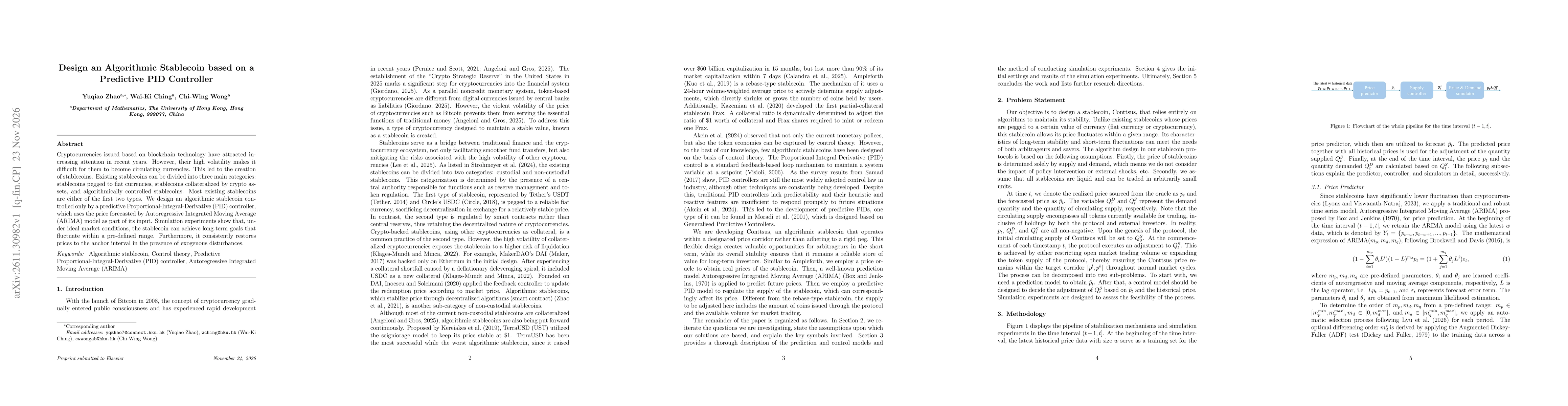
The paper designs an algorithmic stablecoin controlled by a predictive Proportional-Integral-Derivative (PID) controller that incorporates price forecasts generated by an Autoregressive Integrated Moving Average (ARIMA) model as input, and evaluates its performance through simulation experiments.
SignificanceWhy the work matters
The work demonstrates that a purely algorithmic, non‑collateralized stablecoin can achieve price stability using control‑theoretic techniques, offering a novel decentralized alternative to existing fiat‑pegged and crypto‑collateralized stablecoins.
Technical contributionsWhat the work introduces
The paper introduces a predictive PID control framework that integrates ARIMA‑based price forecasts into the smart‑contract logic of an algorithmic stablecoin, and provides a simulation environment to evaluate its stability properties.
NoveltyHow it differs from prior work
Applying a predictive PID controller with ARIMA forecasting to the design of an algorithmic stablecoin is a novel combination of control theory and cryptocurrency economics not previously explored.
Future workQuestions that remain
- Implement and test the predictive PID controller on a live blockchain platform to assess real‑world performance.
- Analyze the robustness of the controller under more realistic market dynamics and adversarial attacks.
Discussion 0