Researchers designed a new method to create visual illusions by finding adversarial examples for probabilistic models of human perception, which can efficiently generate illusions for color constancy, size constancy, and face perception.
Abstract
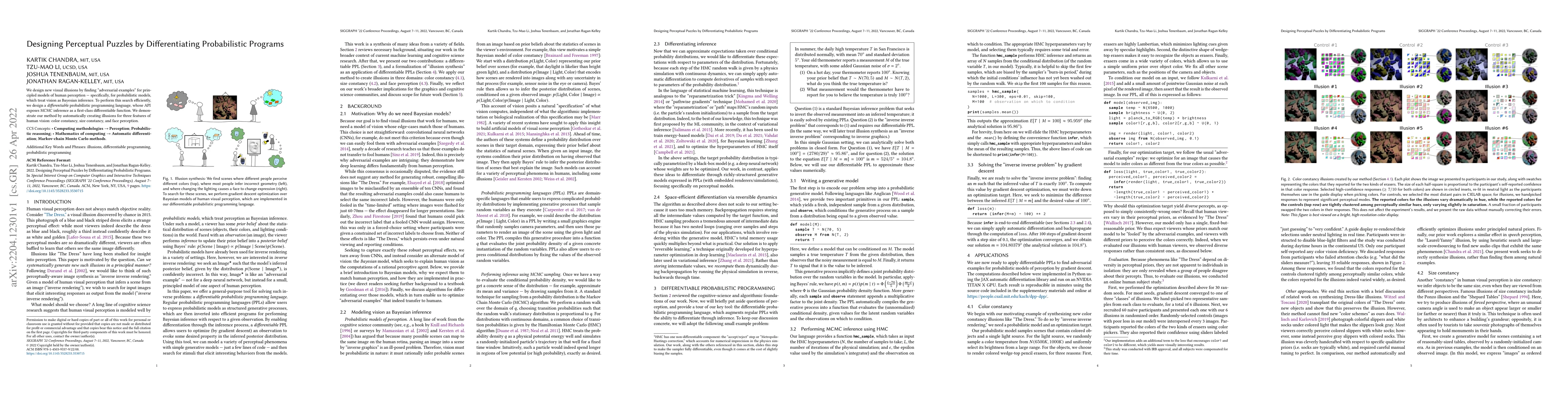
We design new visual illusions by finding "adversarial examples" for principled models of human perception -- specifically, for probabilistic models, which treat vision as Bayesian inference. To perform this search efficiently, we design a differentiable probabilistic programming language, whose API exposes MCMC inference as a first-class differentiable function. We demonstrate our method by automatically creating illusions for three features of human vision: color constancy, size constancy, and face perception.
AI Key Findings
Get AI-generated insights about this paper's methodology, results, significance, and more — available when analysis has been generated.
Discussion 0