Diffutoon-2: Toon Shading with Video Diffusion Models
Abstract
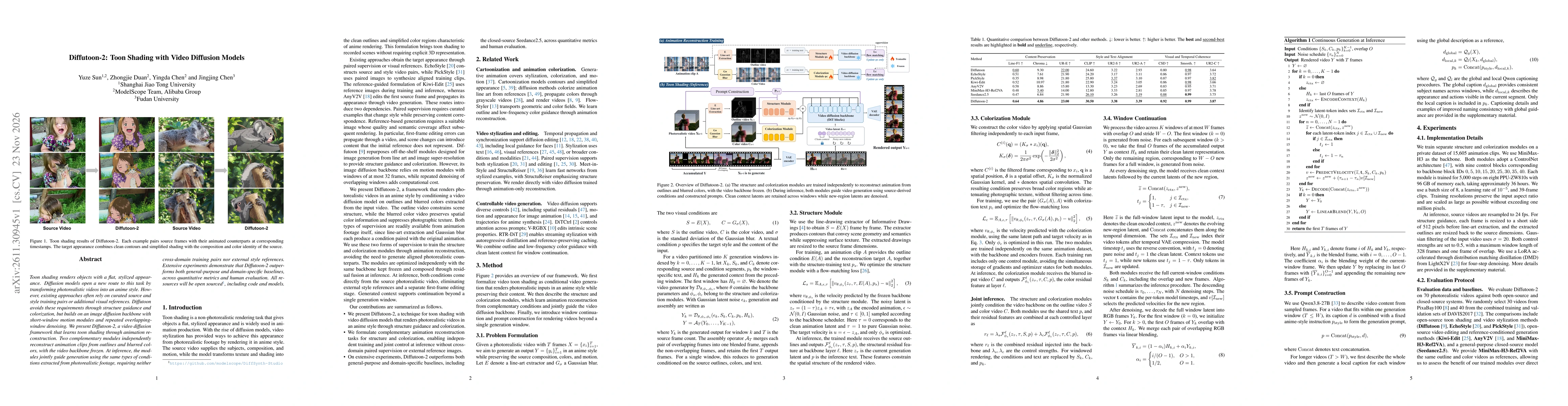
Toon shading renders objects with a flat, stylized appearance. Diffusion models open a new route to this task by transforming photorealistic videos into an anime style. However, existing approaches often rely on curated source and style training pairs or additional visual references. Diffutoon avoids these requirements through structure guidance and colorization, but builds on an image diffusion backbone with short-window motion modules and repeated overlapping-window denoising. We present Diffutoon-2, a video diffusion framework that learns toon shading through animation reconstruction. Two complementary modules independently reconstruct animation clips from outlines and blurred colors, with the video backbone frozen. At inference, the modules jointly guide generation using the same types of conditions extracted from photorealistic footage, requiring neither cross-domain training pairs nor external style references. Extensive experiments demonstrate that Diffutoon-2 outperforms both general-purpose and domain-specific baselines, across quantitative metrics and human evaluation.
Analysis
AI-generated · verify against the original paper
Generated Jan 1, 0001ResultsWhat the authors found
- Diffutoon-2 outperforms both general‑purpose and domain‑specific baselines on quantitative metrics.
- Human evaluation shows a clear preference for Diffutoon-2 outputs over competing methods.
- The framework generates stylized videos without requiring cross‑domain paired training data or external style references.
MethodologyHow the work was done
Diffutoon-2 uses a frozen video diffusion backbone combined with two independent modules that reconstruct animation clips from extracted outlines and blurred colors; the modules are trained separately on structure and colorization tasks and jointly guide generation at inference using conditions derived directly from photorealistic footage.
SignificanceWhy the work matters
The approach enables high‑quality toon shading of real‑world videos while eliminating the need for curated source‑style pairs or reference images, broadening applicability of video diffusion models to animation pipelines.
Technical contributionsWhat the work introduces
Introduces complementary animation reconstruction modules for structure and color guidance that operate on a frozen video diffusion model, allowing controllable toon shading via outline and low‑frequency color conditions.
NoveltyHow it differs from prior work
First video diffusion framework that learns toon shading solely from outline and blurred‑color supervision, removing dependence on paired datasets or external visual references.
Discussion 0