A new framework called Dynamic Low-Order-Aware Fusion (DLF) improves CTR prediction models by balancing explicit-implicit interactions, achieving state-of-the-art performance on public datasets.
Abstract
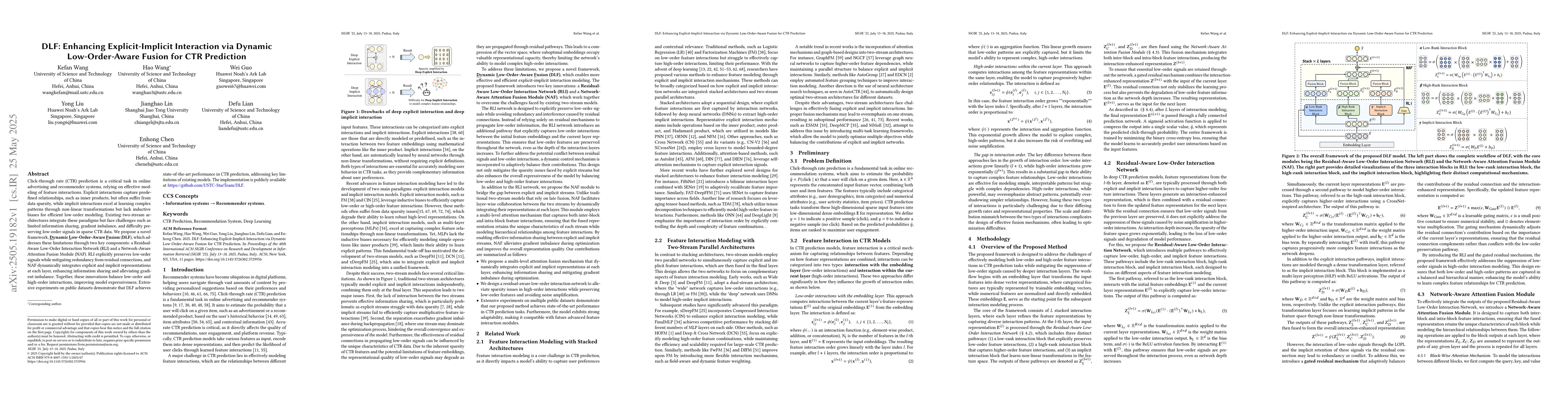
Click-through rate (CTR) prediction is a critical task in online advertising and recommender systems, relying on effective modeling of feature interactions. Explicit interactions capture predefined relationships, such as inner products, but often suffer from data sparsity, while implicit interactions excel at learning complex patterns through non-linear transformations but lack inductive biases for efficient low-order modeling. Existing two-stream architectures integrate these paradigms but face challenges such as limited information sharing, gradient imbalance, and difficulty preserving low-order signals in sparse CTR data. We propose a novel framework, Dynamic Low-Order-Aware Fusion (DLF), which addresses these limitations through two key components: a Residual-Aware Low-Order Interaction Network (RLI) and a Network-Aware Attention Fusion Module (NAF). RLI explicitly preserves low-order signals while mitigating redundancy from residual connections, and NAF dynamically integrates explicit and implicit representations at each layer, enhancing information sharing and alleviating gradient imbalance. Together, these innovations balance low-order and high-order interactions, improving model expressiveness. Extensive experiments on public datasets demonstrate that DLF achieves state-of-the-art performance in CTR prediction, addressing key limitations of existing models. The implementation is publicly available at https://github.com/USTC-StarTeam/DLF.
Analysis
AI-generated · verify against the original paper
Generated Jun 7, 2025ResultsWhat the authors found
- DLF achieves state-of-the-art performance in CTR prediction on public datasets.
- RLI explicitly preserves low-order signals while mitigating redundancy from residual connections.
- NAF dynamically integrates explicit and implicit representations at each layer, enhancing information sharing and alleviating gradient imbalance.
LimitationsWhere the findings need caution
- The paper does not explicitly discuss specific limitations of the proposed method.
- General limitations of CTR prediction models, such as cold-start issues, are not uniquely addressed in this work.
MethodologyHow the work was done
The research proposes Dynamic Low-Order-Aware Fusion (DLF), integrating Residual-Aware Low-Order Interaction Network (RLI) and Network-Aware Attention Fusion Module (NAF) to enhance explicit-implicit feature interaction modeling for CTR prediction, addressing data sparsity and gradient imbalance issues in existing two-stream architectures.
SignificanceWhy the work matters
This research is significant as it improves model expressiveness in CTR prediction, which is crucial for online advertising and recommender systems, by balancing low-order and high-order interactions effectively.
Technical contributionsWhat the work introduces
The main technical contribution is the novel DLF framework, comprising RLI and NAF, which efficiently models both explicit and implicit interactions in sparse CTR data.
NoveltyHow it differs from prior work
DLF distinguishes itself by introducing RLI for low-order signal preservation and NAF for dynamic fusion, addressing challenges in existing two-stream architectures that struggle with information sharing, gradient imbalance, and low-order signal preservation.
Future workQuestions that remain
- Investigate the applicability of DLF in other sequence prediction tasks beyond CTR prediction.
- Explore methods to further improve DLF's performance on imbalanced datasets.
Discussion 0