DynaRC: Dynamics-Robust 4-D Radar Relocalization with Rate-Adaptive Sequence Matching
Abstract
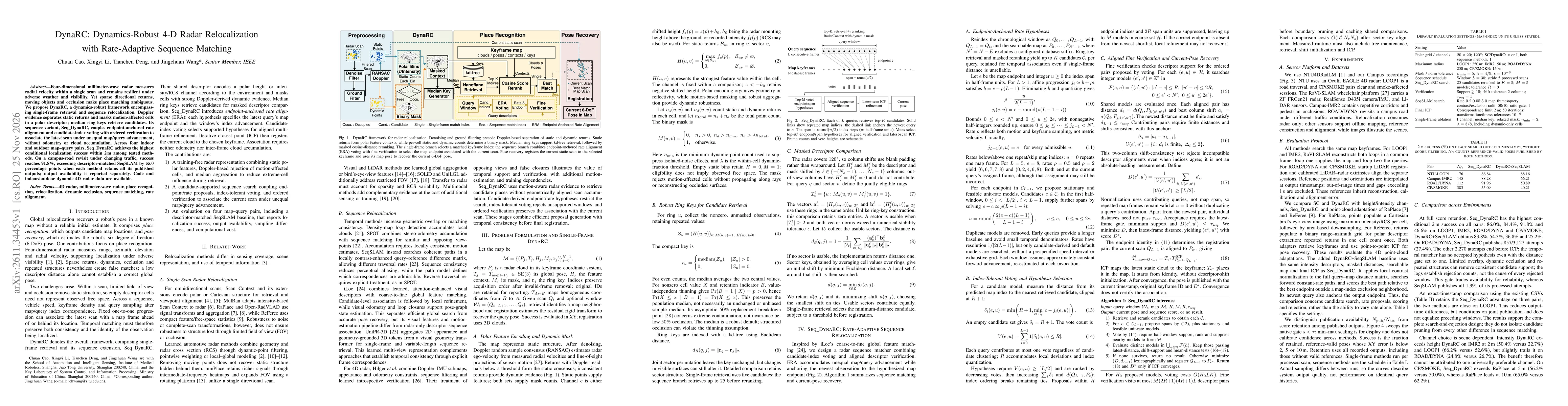
Four-dimensional millimeter-wave radar measures radial velocity within a single scan and remains resilient under adverse weather and visibility. Yet sparse directional returns, moving objects and occlusion make place matching ambiguous. We propose DynaRC, a dynamics-robust framework encompassing single-frame retrieval and sequence relocalization. Doppler evidence separates static returns and masks motion-affected cells in a polar descriptor; median ring keys retrieve candidates. Its sequence variant, Seq_DynaRC, couples endpoint-anchored rate alignment and candidate-index voting with ordered verification to associate the latest scan under unequal map/query advancement, without odometry or cloud accumulation. Across four indoor and outdoor map--query pairs, Seq_DynaRC achieves the highest conditional localization success within 2m among tested methods. On a campus-road revisit under changing traffic, success reaches 91.8%, exceeding descriptor-matched SeqSLAM by 55.0 percentage points when each method retains all its published outputs; output availability is reported separately. Code and indoor/outdoor dynamic 4D radar data are available.
Analysis
AI-generated · verify against the original paper
Generated Jan 1, 0001ResultsWhat the authors found
- Seq_DynaRC achieves the highest conditional localization success within 2 m across four indoor and outdoor map‑query pairs.
- On a campus‑road revisit under changing traffic, Seq_DynaRC attains 91.8% success, surpassing descriptor‑matched SeqSLAM by 55.0 percentage points.
- Ablation studies show that motion handling and median keys raise single‑frame success from 57.4% to 74.9% and sequence success from 78.8% to 92.7% at 2 m.
- Seq_DynaRC runs significantly faster than SeqSLAM, with total per‑attempt times of ~20 ms versus 261 ms on the ROAD/DYNA dataset.
LimitationsWhere the findings need caution
- The approach assumes a static map; heavy occlusion and scene changes can still cause ambiguous matches.
- Masked sectors may break monotonic distance increase, limiting performance under extreme occlusion.
MethodologyHow the work was done
DynaRC builds a training‑free 4D radar representation by denoising scans, using RANSAC‑estimated Doppler to mask motion‑affected cells, aggregating static returns into polar descriptors and median ring keys for kd‑tree retrieval. Seq_DynaRC extends this with endpoint‑anchored rate alignment (ERA) to hypothesize map‑query advancement rates, candidate‑index voting to select supported hypotheses, ordered verification and final ICP registration, all without odometry or inter‑frame cloud accumulation.
SignificanceWhy the work matters
The framework enables robust radar‑only place recognition and relocalization in dynamic, occluded environments without relying on odometry or accumulated point clouds, expanding the applicability of 4D radar for autonomous navigation under adverse conditions.
Technical contributionsWhat the work introduces
A training‑free radar descriptor that combines Doppler‑based static‑dynamic masking with median aggregation for robust single‑frame retrieval, and a candidate‑supported sequence search that uses endpoint‑anchored rate alignment, index‑tolerant voting, and ordered verification to handle unequal map/query advancement.
NoveltyHow it differs from prior work
Introducing motion‑aware radar evidence and rate‑adaptive sequence matching that operate without odometry or cloud accumulation, providing dynamics‑robust relocalization for sparse 4D radar data.
Discussion 0