Efficient Semantic ORDER BY via Transitivity-Aware LLM Batch Sorting
Abstract
Large language models (LLMs) enable declarative semantic sorting through LLM-ORDER BY operators that rank tuples according to natural-language criteria over unstructured data. Executing such operators efficiently is challenging because LLM comparisons are expensive, stochastic, and sometimes inconsistent. Pairwise approaches require many costly calls. Listwise approaches such as external merge sort rank several items per call, but they follow a fixed merge schedule and keep no record of earlier answers: each merge call re-asks orderings that previous calls have already revealed, directly or by transitivity. We present Transitive Batched Sort (TBS), a transitivity-aware physical operator for semantic sorting that records every revealed preference in a global acyclic preference graph and issues a listwise request only for items whose relative order is not yet implied. To scale, TBS stores only directly observed preferences and answers transitivity queries through a memory-efficient reachability index; to handle noisy LLM outputs, it validates responses and rejects cycle-inducing updates. We evaluate TBS on six benchmarks spanning structured sorting, product price ranking, passage ranking, and personalized recommendation with four LLMs. TBS reduces API calls by 12-20x relative to pairwise quicksort and, at the same batch size, uses 1.1-1.6x fewer calls and 1.3-5.3x lower cost than listwise merge sort while achieving competitive or higher ranking quality across most benchmarks; on Amazon it scales to one million products. These results show that reusing previously inferred preference relations, rather than re-querying them, is an effective foundation for scalable semantic ORDER BY operators.
Analysis
AI-generated · verify against the original paper
Generated Jan 1, 0001ResultsWhat the authors found
- TBS reduces API calls by 12–20× compared to pairwise quicksort.
- At equal batch size, TBS uses 1.1–1.6× fewer calls and 1.3–5.3× lower monetary cost than listwise external merge sort.
- The reachability index is 45–1,200× faster and uses 25–83× less peak memory than explicit transitive‑closure approaches.
- Across six benchmarks TBS achieves competitive or higher ranking quality, and it scales to sorting one million Amazon products.
LimitationsWhere the findings need caution
- Noisy and stochastic LLM outputs can produce inconsistent or cyclic preferences, requiring validation and possible rejection of updates.
- Quality degrades for weaker LLMs (e.g., GPT‑4o‑mini) and when batch sizes become too large, limiting the trade‑off between cost savings and ranking accuracy.
MethodologyHow the work was done
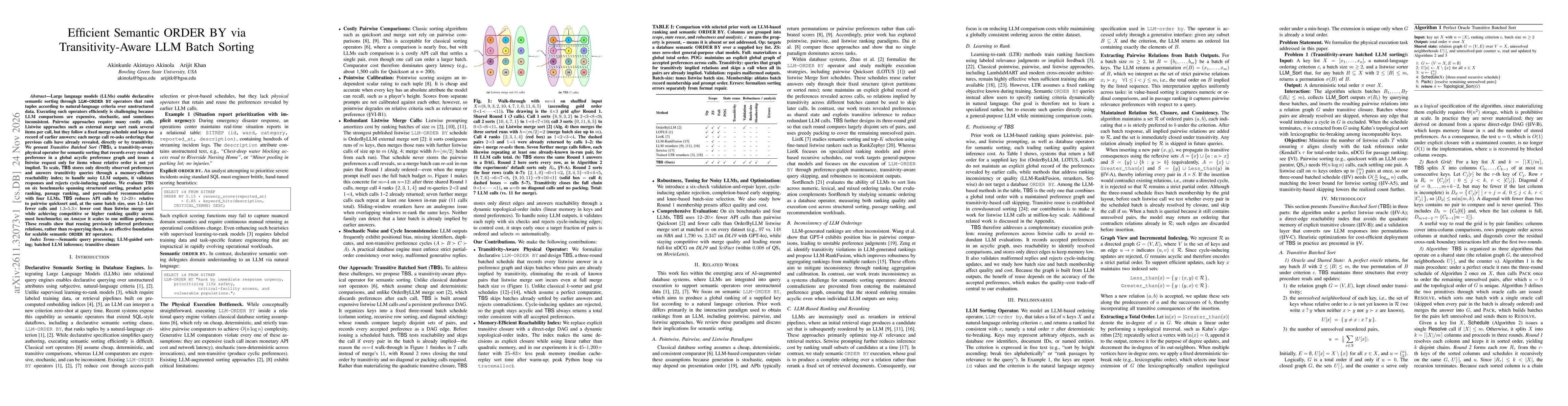
The paper introduces Transitive Batched Sort (TBS), a three‑round batched physical operator that records every listwise LLM ordering as edges in a global acyclic preference DAG, uses a memory‑efficient dynamic topological‑order reachability index to test transitivity, skips listwise calls whose pairwise relations are already implied, validates responses to reject cycle‑inducing updates, and stops early once a target fraction of pairs is ordered.
SignificanceWhy the work matters
By reusing previously inferred preference relations instead of re‑querying them, TBS provides an effective foundation for scalable, cost‑efficient semantic ORDER BY operators in database systems.
Technical contributionsWhat the work introduces
A transitivity‑aware physical operator that maintains a global preference DAG with a dynamic topological‑order index, enabling listwise LLM calls to be issued only for unresolved item pairs while ensuring acyclicity and consistency.
NoveltyHow it differs from prior work
First approach to integrate persistent preference recording and transitivity checking into a batch‑sorted LLM operator, eliminating redundant listwise calls and achieving substantial cost and performance gains.
Discussion 0