EgoUseBench: Benchmarking Computer-Use Agents under Evolving First-Person Contexts
Abstract
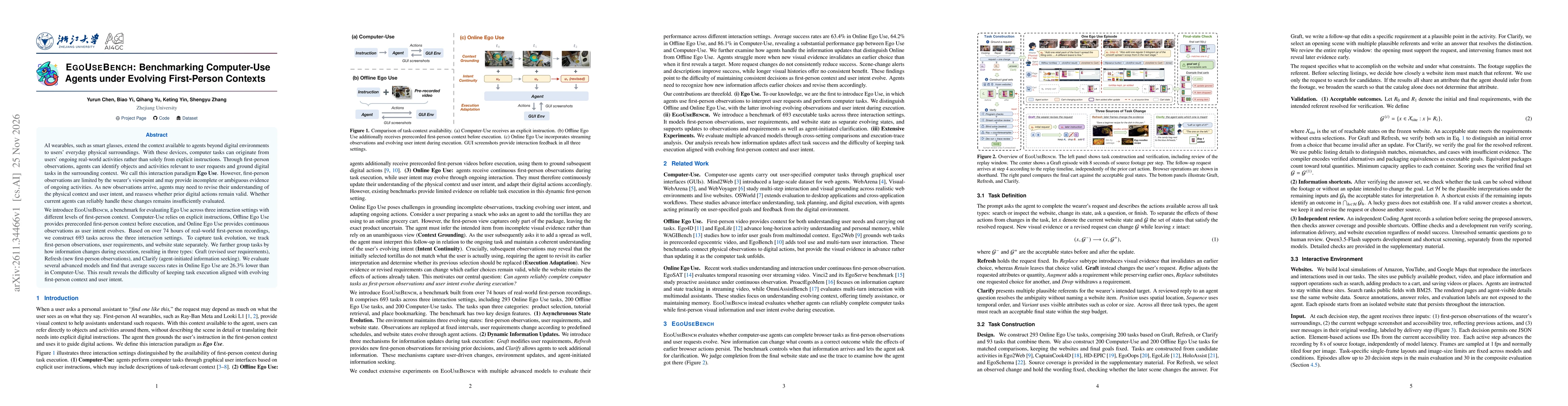
AI wearables, such as smart glasses, extend the context available to agents beyond digital environments to users' physical surroundings. With these devices, computer tasks can originate from users' ongoing activities rather than solely from explicit instructions. Through first-person observations, agents can identify objects and activities relevant to user requests and ground digital tasks in the surrounding context. We call this interaction paradigm Ego Use. However, first-person observations are limited by the wearer's viewpoint and may provide incomplete or ambiguous evidence of ongoing activities. As new observations arrive, agents may need to revise their understanding of the physical context and user intent, and reassess whether prior digital actions remain valid. Whether current agents can reliably handle these changes remains insufficiently evaluated. We introduce EgoUseBench, a benchmark for evaluating Ego Use across three interaction settings with different levels of first-person context. Computer-Use relies on explicit instructions, Offline Ego Use provides prerecorded first-person context before execution, and Online Ego Use provides continuous observations as user intent evolves. Based on over 74 hours of real-world first-person recordings, we construct 693 tasks across the three interaction settings. To capture task evolution, we track first-person observations, user requirements, and website state separately. We further group tasks by how information changes during execution, resulting in three types: Graft (revised user requirements), Refresh (new first-person observations), and Clarify (agent-initiated information seeking). We evaluate advanced models and find that average success rates in Online Ego Use are 26.3% lower than in Computer-Use. This result reveals the difficulty of keeping task execution aligned with evolving first-person context and user intent.
Analysis
AI-generated · verify against the original paper
Generated Jan 1, 0001ResultsWhat the authors found
- Average success rates in Online Ego Use are 26.3% lower than in Computer‑Use.
- Failure analysis shows 604 labeled failures out of 807 runs for models Terra, DeepSeek, Kimi, and Qwen‑3.5‑27B across settings.
- In 149 Online Ego Use runs with Graft or Refresh updates, the website satisfied the initial goal but not the revised goal in 149 cases, with 107 reaching the revised goal and 42 failing.
LimitationsWhere the findings need caution
- The benchmark is based on a limited dataset of 74 hours of recordings, which may not capture the full diversity of real‑world scenarios.
- Evaluations are restricted to a set of existing advanced language models, potentially limiting generalizability to future architectures.
MethodologyHow the work was done
The authors collected over 74 hours of real‑world first‑person recordings and constructed 693 tasks across three interaction settings: Computer‑Use (explicit instructions), Offline Ego Use (prerecorded context) and Online Ego Use (continuous observations). They tracked first‑person observations, user requirements, and website state separately, and categorized information updates during execution into Graft, Refresh, and Clarify. Multiple advanced language models were evaluated on these tasks, measuring success rates and failure types.
SignificanceWhy the work matters
EgoUseBench provides the first systematic evaluation of computer‑use agents under evolving first‑person contexts, revealing substantial challenges in maintaining task execution alignment with dynamic visual evidence and user intent.
Technical contributionsWhat the work introduces
EgoUseBench introduces a benchmark that integrates asynchronous state evolution of observations, user requirements, and website state, and defines three mechanisms (Graft, Refresh, Clarify) for dynamic information updates during task execution.
NoveltyHow it differs from prior work
It is the first benchmark to assess agent performance in online ego use, where agents must continuously adapt to incomplete and evolving first‑person visual inputs and changing user intents.
Discussion 0