Abstract
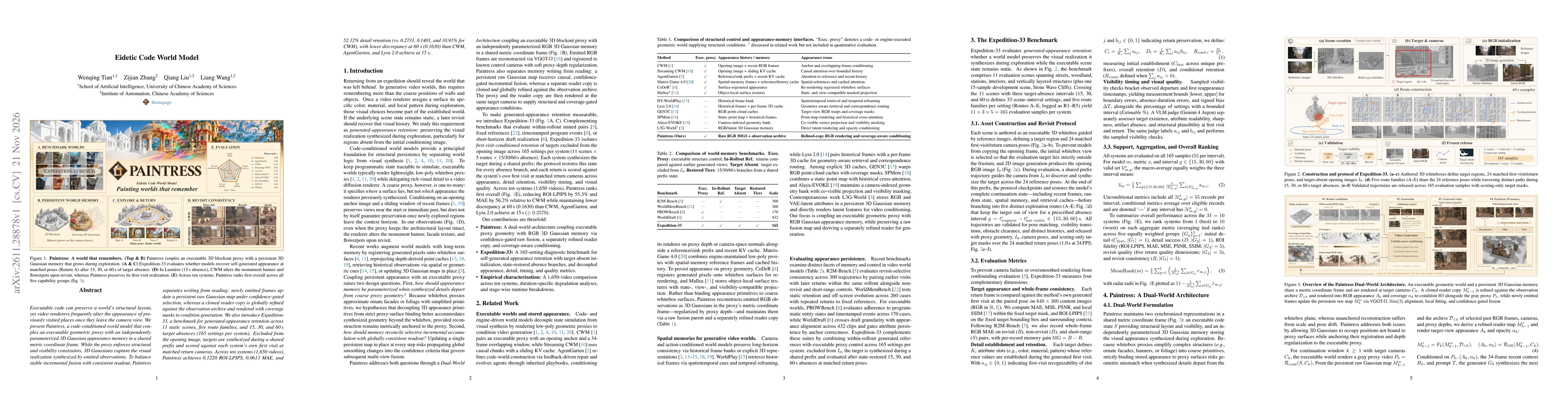
Executable code can preserve a world's structural layout, yet video renderers frequently alter the appearance of previously visited places once they leave the camera view. We present Paintress, a code-conditioned world model that couples an executable geometric proxy with an independently parameterized 3D Gaussian appearance memory in a shared metric coordinate frame. While the proxy enforces structural and visibility constraints, 3D Gaussians capture the visual realization synthesized by emitted observations. To balance stable incremental fusion with consistent readout, Paintress separates writing from reading: newly emitted frames update a persistent raw Gaussian map under confidence-gated selection, whereas a cloned reader copy is globally refined against the observation archive and rendered with coverage masks to condition generation. We also introduce Expedition-33, a benchmark for generated-appearance retention across 11 static scenes, five route families, and 15, 30, and 60 s target absences (165 settings per system). Excluded from the opening image, targets are synthesized during a shared prefix and scored against each system's own first visit at matched return cameras. Across ten systems (1,650 videos), Paintress achieves 0.1220 ROI-LPIPS, 0.0613 MAE, and 52.12% detail retention (vs. 0.2731, 0.1401, and 10.91% for CWM), with lower discrepancy at 60 s (0.1630) than CWM, AgentGarten, and Lyra 2.0 achieve at 15 s.
AI Key Findings
Get AI-generated insights about this paper's methodology, results, significance, and more — available when analysis has been generated.
Discussion 0