Electron Density Reconstruction of Solar Coronal Mass Ejections Based on a Genetic Algorithm: Method and Application
This paper introduces a genetic reconstruction method (GRM) to reconstruct the 3D electron density of coronal mass ejections (CMEs) using synthetic and real coronagraph data. GRM's performance is tested on synthetic CMEs with varying orientations and shapes, showing its effectiveness despite brightness incompleteness and noise.
Abstract
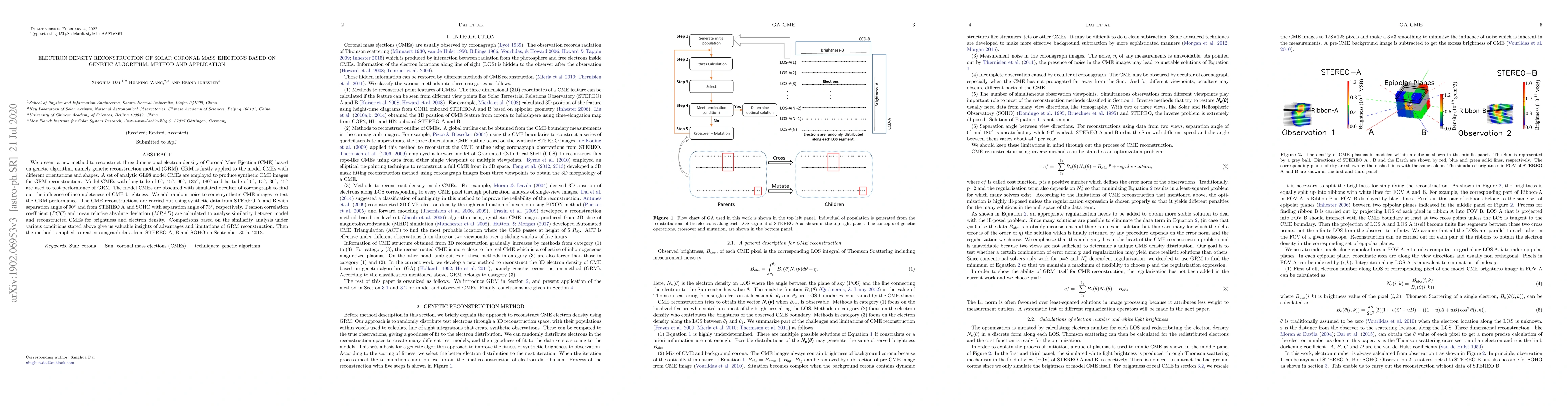
We present a new method to reconstruct the three-dimensional electron density of coronal mass ejections (CMEs) based on a genetic algorithm, namely the genetic reconstruction method (GRM). GRM is first applied to model CMEs with different orientations and shapes. A set of analytic model CMEs from Gibson and Low is employed to produce synthetic CME images for GRM reconstruction. Model CMEs with longitudes of 0, 45, 90, 135, 180 degrees and latitudes of 0, 15, 30, 45 degrees are used to test the performance of GRM. The model CMEs are obscured with a simulated occulter of a coronagraph to determine the influence of CME brightness incompleteness. We add random noise to some synthetic CME images to test the performance of GRM. The CME reconstructions are carried out using synthetic data from Solar Terrestrial Relations Observatory (STEREO) A and B with a separation angle of 90 degrees and from STEREO A and the Solar and Heliospheric Observatory (SOHO) with a separation angle of 73 degrees. The Pearson correlation coefficient and the mean relative absolute deviation are calculated to analyze the similarities in brightness and electron density between the model and reconstructed CMEs. Comparisons based on the similarity analysis under various conditions stated above give us valuable insights into the advantages and limitations of GRM reconstruction. The method is then applied to real coronagraph data from STEREO A and B, and SOHO on 2013 September 30.
AI Key Findings
Get AI-generated insights about this paper's methodology, results, significance, and more — available when analysis has been generated.
Discussion 0