Entropy-Gated Dynamic Rectification for Object Hallucination in Large Vision-Language Models
Abstract
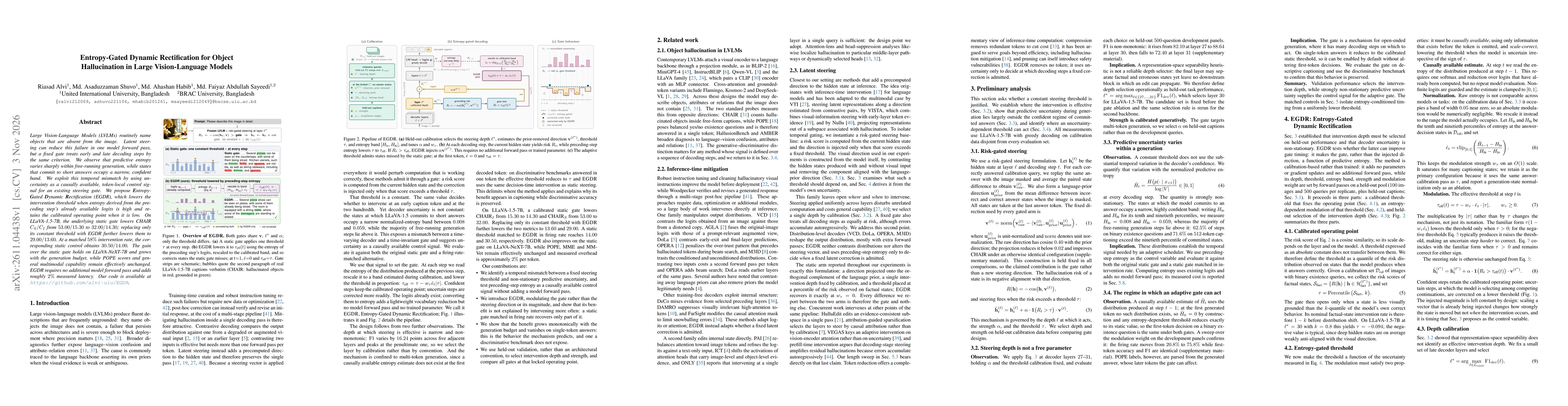
Large Vision-Language Models (LVLMs) routinely name objects that are absent from the image. Latent steering can reduce this failure in one model forward pass, but a fixed gate treats early and late decoding steps by the same criterion. We observe that predictive entropy varies sharply within free-running generation, while states that commit to short answers occupy a narrow, confident band. We exploit this temporal mismatch by using uncertainty as a causally available, token-local control signal for an existing steering gate. We propose Entropy-Gated Dynamic Rectification (EGDR), which lowers the intervention threshold when entropy derived from the preceding step's already available logits is high and retains the calibrated operating point when it is low. On LLaVA-1.5-7B, the underlying static gate lowers CHAIR CS/CI from 53.00/15.30 to 32.00/14.30; replacing only its constant threshold with EGDR further lowers them to 29.00/13.60. At a matched 58% intervention rate, the corresponding static control obtains 30.50/14.00. The gain over the static gate holds on LLaVA-NeXT-7B and grows with the generation budget, while POPE scores and general multimodal capability remain effectively unchanged. EGDR requires no additional model forward pass and adds roughly 2% measured latency. Our code is available at https://github.com/alvi-uiu/EGDR.
Analysis
AI-generated · verify against the original paper
Generated Jan 1, 0001ResultsWhat the authors found
- On LLaVA-1.5-7B, EGDR reduces CHAIR CS/CI from 53.00/15.30 (baseline) to 29.00/13.60, improving over the static gate (32.00/14.30).
- At a matched 58% intervention rate, the static gate achieves 30.50/14.00, still higher than EGDR.
- EGDR’s benefit grows with larger generation budgets and also improves results on LLaVA-NeXT-7B.
- POPE, MME, and MM-Vet scores remain effectively unchanged, indicating preserved multimodal capability.
- EGDR adds roughly 2% latency per token and requires no extra model forward pass.
LimitationsWhere the findings need caution
- The method relies on entropy estimates that are unavailable for the first token, limiting its applicability to multi‑token generation.
- The hallucination reduction effect vanishes for single‑token answers, where the static gate already performs well.
MethodologyHow the work was done
EGDR computes predictive entropy from the preceding step's logits, rescales it to a calibrated band, and dynamically lowers the intervention threshold of a static steering gate when entropy is high, while keeping the calibrated operating point when entropy is low, all without additional forward passes.
SignificanceWhy the work matters
The approach substantially mitigates object hallucination in LVLMs while preserving overall performance and incurring minimal computational overhead, making it practical for real‑time deployment.
Technical contributionsWhat the work introduces
Introduction of Entropy‑Gated Dynamic Rectification (EGDR), a token‑local, causally available control signal that adaptively modulates the steering gate threshold based on predictive uncertainty.
NoveltyHow it differs from prior work
Dynamic, entropy‑driven adjustment of a static steering gate threshold, contrasting with prior fixed‑threshold or multi‑pass interventions.
Discussion 0