EventDiffusion: Learning Native Event Stream Distribution from Videos
Abstract
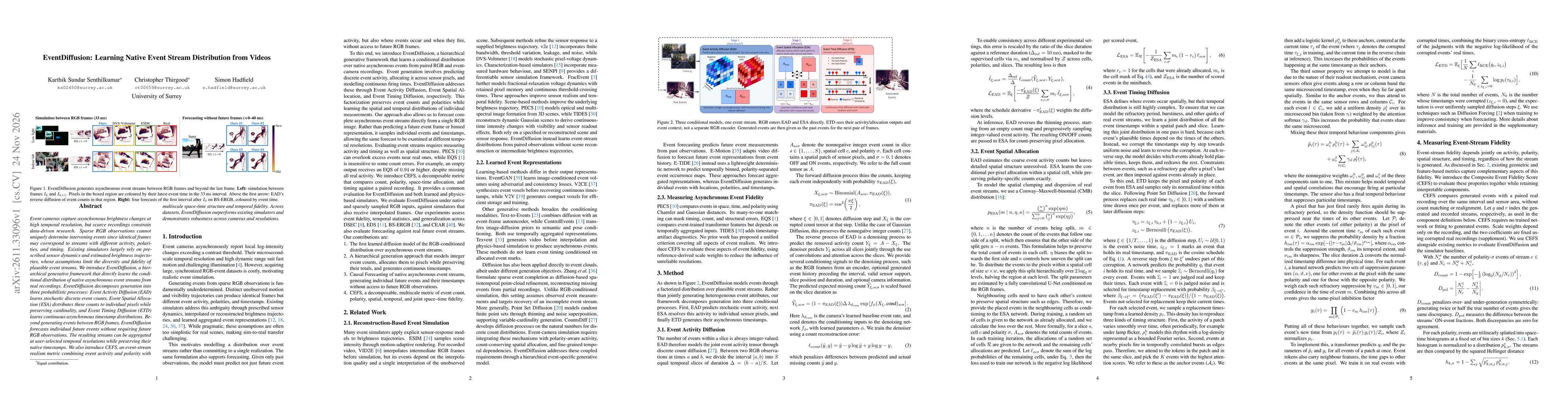
Event cameras capture asynchronous brightness changes at high temporal resolution, but scarce recordings constrain data-driven research. Sparse RGB observations cannot uniquely determine intervening events since identical frames may correspond to streams with different activity, polarities, and timing. Existing simulators largely rely on prescribed sensor dynamics and estimated brightness trajectories, whose assumptions limit the diversity and fidelity of plausible event streams. We introduce EventDiffusion, a hierarchical generative framework that directly learns the conditional distribution of native asynchronous event streams from real recordings. EventDiffusion decomposes generation into three probabilistic processes: Event Activity Diffusion (EAD) learns stochastic discrete event counts; Event Spatial Allocation (ESA) distributes these counts to individual pixels while preserving cardinality; and Event Timing Diffusion (ETD) learns continuous asynchronous timestamp distributions. We also introduce CEFS, an event-stream realism metric combining event activity and polarity with multiscale space-time structure and temporal fidelity. Across all datasets, EventDiffusion achieves double the accuracy of SOTA methods and demonstrates robustness across different cameras at any resolution.
Analysis
AI-generated · verify against the original paper
Generated Jan 1, 0001ResultsWhat the authors found
- Across all datasets, EventDiffusion achieves roughly double the accuracy of state‑of‑the‑art simulators.
- The method demonstrates robustness across different event cameras and resolutions.
- The proposed CEFS realism metric shows high correlation (ρ≈0.81) with downstream task degradation, outperforming existing metrics such as PECS and EQS.
MethodologyHow the work was done
EventDiffusion is a hierarchical generative framework that learns the conditional distribution of native asynchronous event streams from paired RGB and event recordings. It decomposes generation into three probabilistic processes: Event Activity Diffusion (EAD) for stochastic discrete event counts, Event Spatial Allocation (ESA) for distributing counts to pixels while preserving cardinality, and Event Timing Diffusion (ETD) for continuous timestamp distributions.
SignificanceWhy the work matters
By learning a distribution over event streams rather than a single deterministic simulation, EventDiffusion enables realistic event generation and causal forecasting from a single RGB frame, facilitating data‑driven research despite scarce recordings.
Technical contributionsWhat the work introduces
Introduces the first diffusion‑based model that directly learns the RGB‑conditioned distribution of asynchronous event streams, a hierarchical generation pipeline (EAD, ESA, ETD), and the CEFS metric for comprehensive event‑stream realism evaluation.
NoveltyHow it differs from prior work
Directly models the conditional distribution of native event streams using a hierarchical diffusion process, eliminating the need for explicit sensor dynamics or brightness trajectory reconstruction and supporting future event forecasting without future RGB inputs.
Discussion 0