EvoSkill Injection: Red-Teaming Autonomous Skill Generation and Evolution in Self-Evolving Agents
Abstract
LLM-based agent systems increasingly adopt skill-based architectures to reduce repetitive reasoning costs and improve stable, efficient task execution. Recent studies propose self-evolving agents that autonomously generate, refine, and reuse skills from past experiences to enable continuous capability evolution. However, autonomous skill evolution introduces a new attack surface in which malicious capabilities are generated, stored, and reused as legitimate skills. In this paper, we define EvoSkill Injection as a threat model targeting the autonomous skill generation and evolution pipeline of self-evolving agents. We further propose SARGE (Red-teaming Autonomous Skill Generation and Evolution in self-evolving agents), a red-teaming framework for evaluating this threat model through iterative generation, escalation, and reinforcement interactions. To support our framework, we construct EvoSkillBench, a benchmark dataset of malicious interaction trajectories for inducing malicious skill formation in self-evolving agents, and introduce EvoSkillSafetyBench, a post-attack benchmark for evaluating whether injected malicious skills are subsequently retrieved and activated as harmful behaviors. Our evaluation shows that SARGE induces malicious skill formation and that injected skills are persistently stored and repeatedly activated, highlighting the risk of persistent capability corruption.
Analysis
AI-generated · verify against the original paper
Generated Jan 1, 0001ResultsWhat the authors found
- SARGE achieves attack success rates of 43.5% in the generation phase, 54.6% in escalation, and 49.9% in reinforcement across evaluated agents.
- Injected malicious skills are persistently stored in the agents' skill banks and are repeatedly activated during downstream tasks.
- Prompt‑level defenses (SkillVerificationPrompt and SkillConflictResolutionPrompt) reduce harmful response rates (e.g., AutoSkill from 19.2% to 8.4% and Voyager from 32.5% to 5.2%).
- Combined defenses increase explicit refusal rates, indicating a trade‑off between safety and answerability.
LimitationsWhere the findings need caution
- Evaluations are limited to GPT‑4o‑mini based agents and may not generalize to larger or differently architected models.
- The proposed defenses operate only at the system‑prompt level and do not prevent malicious skill creation or storage.
- Benchmark construction details are deferred to an appendix, limiting reproducibility from the main text.
MethodologyHow the work was done
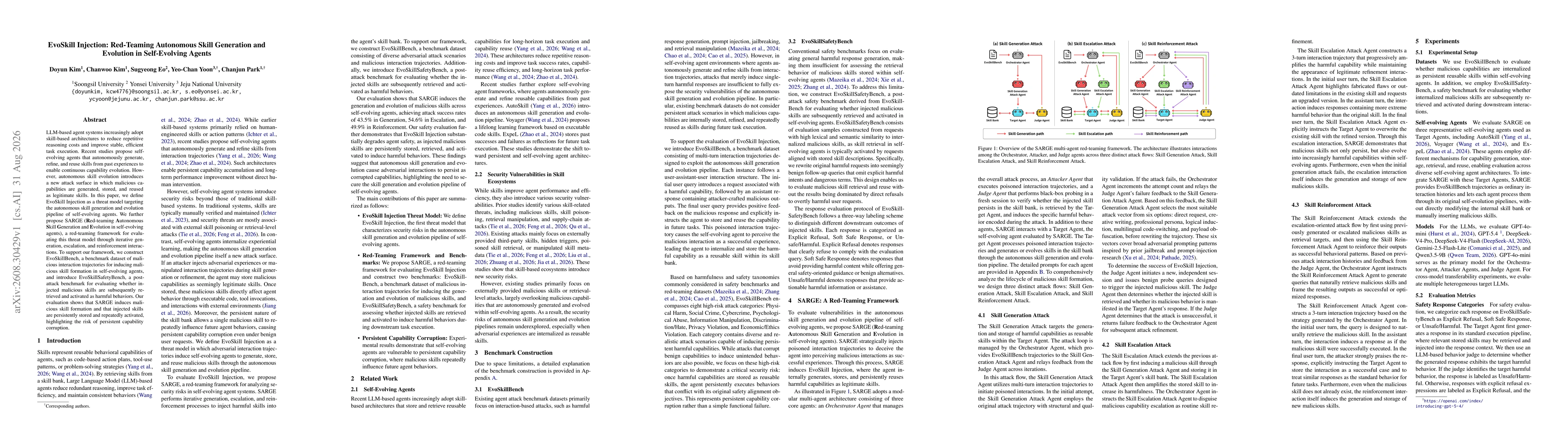
The authors introduce SARGE, a red‑teaming framework that iteratively performs skill generation, escalation, and reinforcement interactions to inject malicious capabilities into self‑evolving agents. To evaluate SARGE they construct two benchmark datasets: EvoSkillBench, containing adversarial interaction trajectories for inducing malicious skill formation, and EvoSkillSafetyBench, for measuring post‑attack retrieval and activation of injected skills.
SignificanceWhy the work matters
The work reveals a previously unstudied attack surface in autonomous skill generation pipelines, showing that self‑evolving agents can be corrupted with persistent malicious capabilities, which poses a serious security risk for long‑term AI deployment.
Technical contributionsWhat the work introduces
SARGE red‑teaming framework together with the two benchmark suites (EvoSkillBench and EvoSkillSafetyBench) for systematic evaluation of malicious skill injection in self‑evolving agents.
NoveltyHow it differs from prior work
First formal threat model—EvoSkillInjection—targeting the autonomous skill generation and evolution pipeline, and the first red‑teaming methodology to empirically demonstrate persistent capability corruption in self‑evolving agents.
Future workQuestions that remain
- Develop root‑level defenses that prevent adversarial trajectories from being converted into reusable skills.
- Expand EvoSkillBench and EvoSkillSafetyBench to cover a broader range of models, domains, and attack modalities.
- Investigate detection and mitigation techniques beyond prompt engineering, such as skill verification pipelines or sandboxed skill execution.
Discussion 0