Exact finite-time fluctuation-response relations for Markov processes: A martingale framework
Abstract
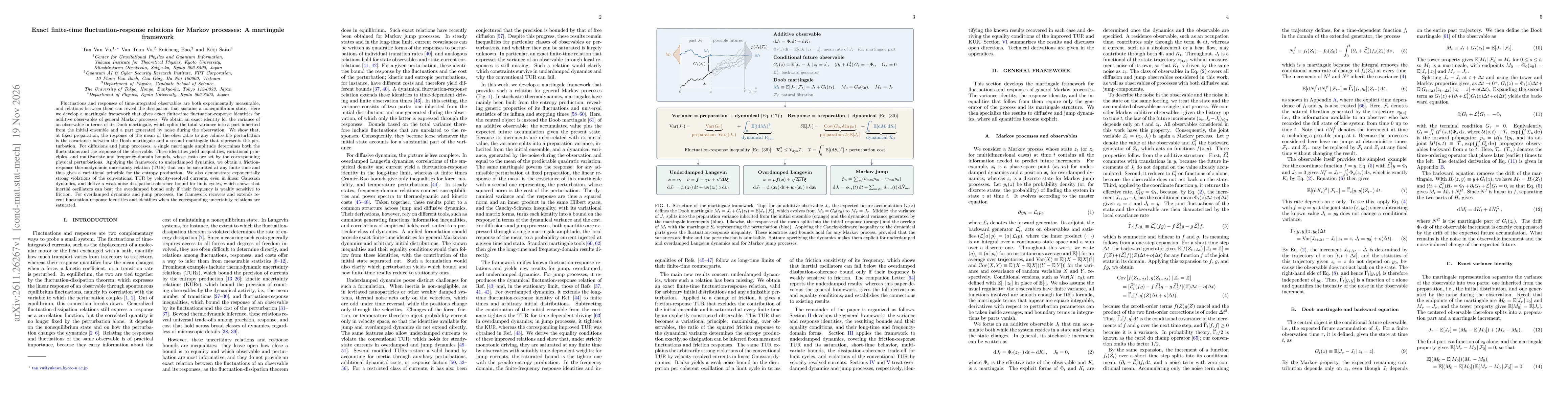
Fluctuations and responses of time-integrated observables are both experimentally measurable, and relations between them can reveal the dissipation that sustains a nonequilibrium state. Here we develop a martingale framework that gives exact finite-time fluctuation-response identities for additive observables of general Markov processes. We obtain an exact identity for the variance of an observable in terms of its Doob martingale, which splits the total variance into a part inherited from the initial ensemble and a part generated by noise during the observation. We show that, at fixed preparation, the response of the mean of the observable to any admissible perturbation is the covariance between the Doob martingale and a second martingale that represents the perturbation. For diffusions and jump processes, a single martingale amplitude determines both the fluctuations and the response of the observable. These identities yield inequalities, variational principles, and multivariate and frequency-domain bounds, whose costs are set by the corresponding physical perturbations. Applying the framework to underdamped dynamics, we obtain a friction-response thermodynamic uncertainty relation (TUR) that can be saturated at any finite time and thus gives a variational principle for the entropy production. We also demonstrate exponentially strong violations of the conventional TUR by velocity-resolved currents, even in linear Gaussian dynamics, and derive a weak-noise dissipation-coherence bound for limit cycles, which shows that inertial oscillators can beat the overdamped bound only if their frequency is weakly sensitive to friction. For overdamped dynamics and jump processes, the framework recovers and extends recent fluctuation-response identities and identifies when the corresponding uncertainty relations are saturated.
Analysis
AI-generated · verify against the original paper
Generated Jan 1, 0001ResultsWhat the authors found
- An exact identity for the variance of an observable splits it into a preparation variance and a dynamical variance generated by noise.
- The linear response of the observable mean to any admissible perturbation equals the covariance between the Doob martingale and a perturbation martingale.
- For diffusions and jump processes a single martingale amplitude determines both fluctuations and response, yielding inequalities, variational principles, and multivariate/frequency-domain bounds.
- Application to underdamped dynamics produces a friction-response thermodynamic uncertainty relation (TUR) that can be saturated at any finite time, providing a variational principle for entropy production.
- Demonstration of exponentially strong violations of the conventional TUR by velocity-resolved currents, even in linear Gaussian dynamics.
- Derivation of a weak‑noise dissipation‑coherence bound for limit cycles, showing inertial oscillators can surpass the overdamped bound only if their frequency is weakly sensitive to friction.
LimitationsWhere the findings need caution
- The framework assumes additive observables and admissible perturbations that can be represented by a second martingale, which may not cover all possible observables or perturbation types.
- Derivations rely on the existence of the Doob martingale and its quadratic variation, limiting applicability to processes where these constructs are well‑defined.
MethodologyHow the work was done
The authors develop a martingale framework based on the Doob martingale of additive observables in general Markov processes, deriving exact finite-time fluctuation-response identities by expressing variance and response in terms of martingale covariances and norms.
SignificanceWhy the work matters
The work unifies and extends fluctuation‑response relations across jump, overdamped, and underdamped Markov dynamics, offering exact finite‑time identities that clarify the role of initial conditions, tighten existing uncertainty relations, and enable precise inference of dissipation from measurable fluctuations and responses.
Technical contributionsWhat the work introduces
The paper introduces a unified martingale formalism that yields exact finite‑time fluctuation‑response identities for general Markov processes, linking variance decomposition and response via covariances of Doob martingales, and derives new uncertainty relations and bounds.
NoveltyHow it differs from prior work
It provides the first exact finite‑time variance‑response identity for general Markov processes using a Doob martingale, and discovers a saturable friction‑response TUR for underdamped dynamics, revealing strong violations of conventional TURs.
Future workQuestions that remain
- Extending the martingale approach to non‑additive or path‑dependent observables and to non‑Markovian dynamics.
- Exploring experimental implementations of the derived finite‑time relations in complex systems such as active matter or quantum stochastic processes.
Discussion 0