Failed Oort Clouds and Planetary Migration
This paper explores how rapid planetary migration can lead to the formation of "failed Oort clouds," which are comet clouds that remain intermediate between a Kuiper Belt and a true Oort cloud. These structures may serve as evidence of planetary migration and potentially allow for the observation of planetary embryos via transits.
Abstract
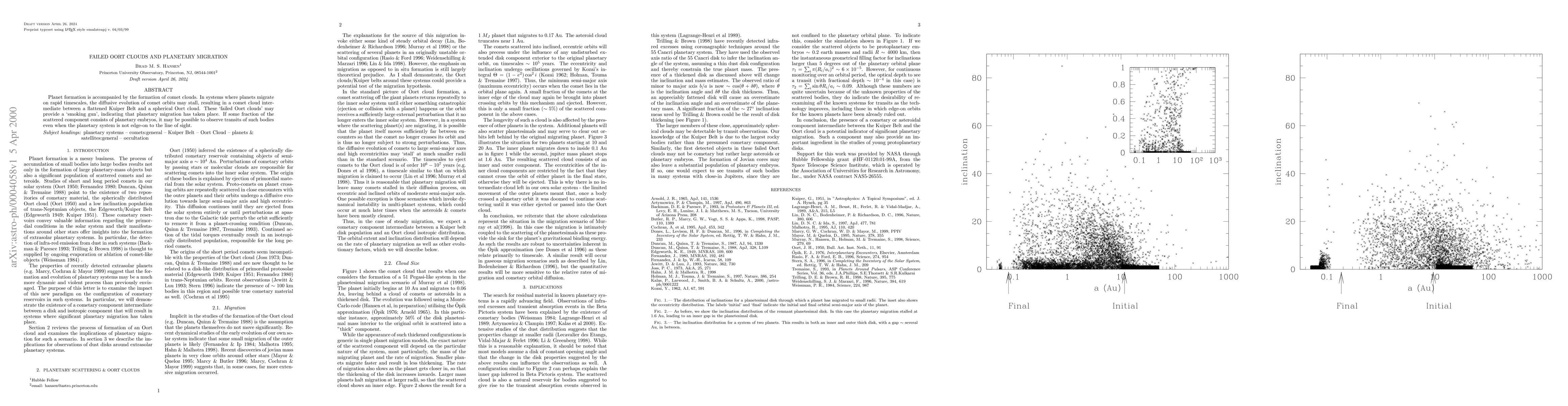
Planet formation is accompanied by the formation of comet clouds. In systems where planets migrate on rapid timescales, the diffusive evolution of comet orbits may stall, resulting in a comet cloud intermediate between a flattened Kuiper Belt and a spherical Oort cloud. These `failed Oort clouds' may provide a `smoking gun', indicating that planetary migration has taken place. If some fraction of the scattered component consists of planetary embryos, it may be possible to observe transits of such bodies even when the planetary system is not edge-on to the line of sight.
AI Key Findings
Get AI-generated insights about this paper's methodology, results, significance, and more — available when analysis has been generated.
Discussion 0