Fedora: An Architecture for Complex Objects and their Relationships
Fedora is an extensible framework for managing complex objects and their relationships, implemented as open-source software. It supports aggregation, service association, and dynamic representation, utilizing an RDF-based relationship model and RDF triple store for querying.
Abstract
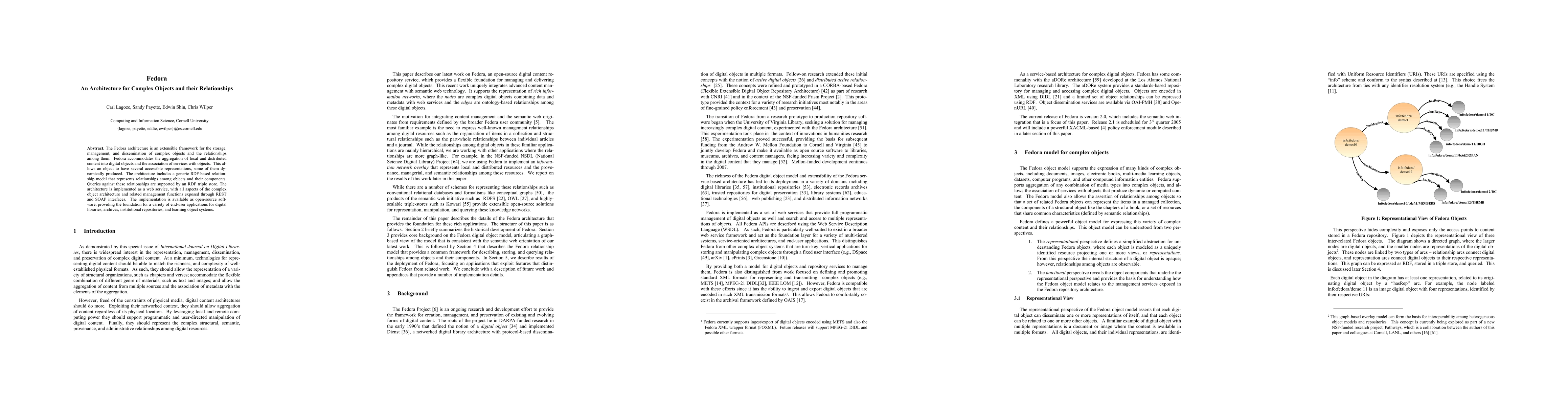
The Fedora architecture is an extensible framework for the storage, management, and dissemination of complex objects and the relationships among them. Fedora accommodates the aggregation of local and distributed content into digital objects and the association of services with objects. This al-lows an object to have several accessible representations, some of them dy-namically produced. The architecture includes a generic RDF-based relation-ship model that represents relationships among objects and their components. Queries against these relationships are supported by an RDF triple store. The architecture is implemented as a web service, with all aspects of the complex object architecture and related management functions exposed through REST and SOAP interfaces. The implementation is available as open-source soft-ware, providing the foundation for a variety of end-user applications for digital libraries, archives, institutional repositories, and learning object systems.
AI Key Findings
Get AI-generated insights about this paper's methodology, results, significance, and more — available when analysis has been generated.
Discussion 0