Fold the Loop: Decoding-Time KV Memory for Looped Vision-Language Models
Abstract
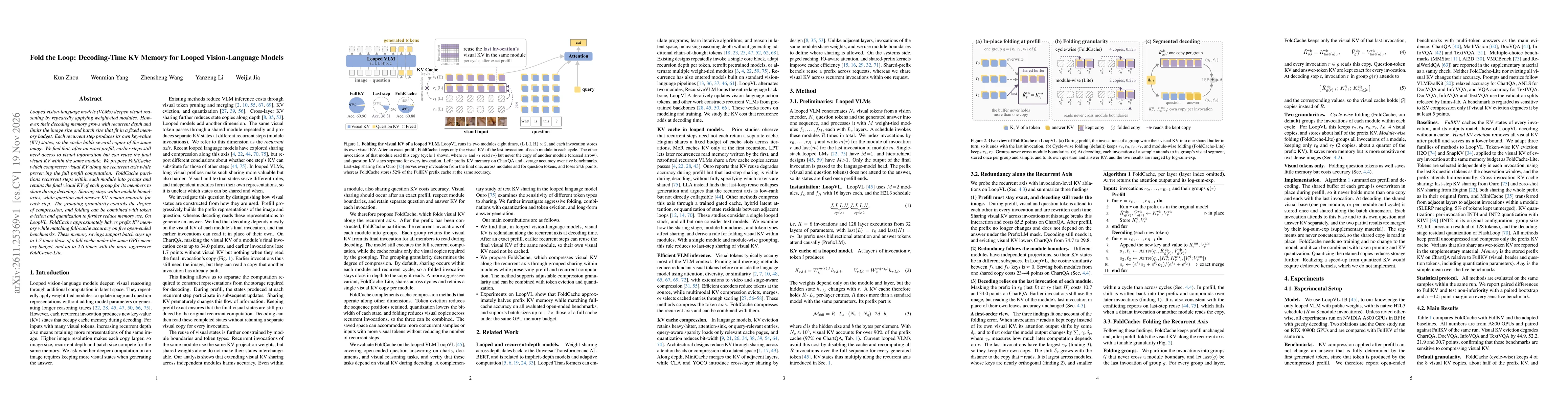
Looped vision-language models (VLMs) deepen visual reasoning by repeatedly applying weight-tied modules. However, their decoding memory grows with recurrent depth and limits the image size and batch size that fit in a fixed memory budget. Each recurrent step produces its own key-value (KV) states, so the cache holds several copies of the same image. We find that, after an exact prefill, earlier steps still need access to visual information but can reuse the final visual KV within the same module. We propose FoldCache, which compresses visual KV along the recurrent axis while preserving the full prefill computation. FoldCache partitions recurrent steps within each module into groups and retains the final visual KV of each group for its members to share during decoding. Sharing stays within module boundaries, while question and answer KV remain separate for each step. The grouping granularity controls the degree of compression, and folding can be combined with token eviction and quantization to further reduce memory use. On LoopVL, FoldCache approximately halves prefix KV memory while matching full-cache accuracy on five open-ended benchmarks. These memory savings support batch sizes up to 1.7 times those of a full cache under the same GPU memory budget, and up to 2.6 times with the more aggressive FoldCache-Lite.
Analysis
AI-generated · verify against the original paper
Generated Jan 1, 0001ResultsWhat the authors found
- FoldCache approximately halves prefix KV memory while matching full‑cache accuracy on five open‑ended benchmarks.
- The memory savings enable batch sizes up to 1.7× larger than full‑cache under the same GPU budget, and up to 2.6× with the more aggressive FoldCache‑Lite variant.
- Ablation shows that masking the final visual KV of a module drops accuracy up to 34 points, whereas reusing it incurs negligible loss.
LimitationsWhere the findings need caution
- The rule that earlier steps can reuse the final visual KV is validated only on the LoopVL model and not on other hierarchical looped VLMs.
- Aggressive grouping granularity is more sensitive on text‑dense images, leading to larger accuracy drops.
MethodologyHow the work was done
FoldCache partitions recurrent steps within each weight‑tied module into groups and retains only the final visual KV of each group for all members to share during decoding, while keeping question and answer KV separate; the grouping granularity controls compression and can be combined with token eviction and quantization.
SignificanceWhy the work matters
By reducing the decoding‑time visual KV footprint, FoldCache allows looped VLMs to process higher‑resolution images and larger batches without increasing model parameters, expanding the practical applicability of deep visual reasoning.
Technical contributionsWhat the work introduces
Introduces FoldCache, a KV‑compression technique that folds visual KV along the recurrent axis by grouping module invocations, preserving exact prefill computation while drastically reducing memory usage.
NoveltyHow it differs from prior work
First work to demonstrate that after an exact prefill, earlier recurrent steps can safely read the final visual KV of the same module, enabling systematic, adjustable KV sharing across recurrent depth.
Future workQuestions that remain
- Validate the visual KV sharing rule on other publicly available looped VLMs.
- Investigate finer‑grained or adaptive grouping strategies to mitigate sensitivity on text‑dense inputs.
- Develop fused attention kernels to eliminate the fixed per‑step overhead introduced by separate segment processing.
Discussion 0