Foresight Forcing: Learning Spatial Foresight for Robotic Manipulation
Abstract
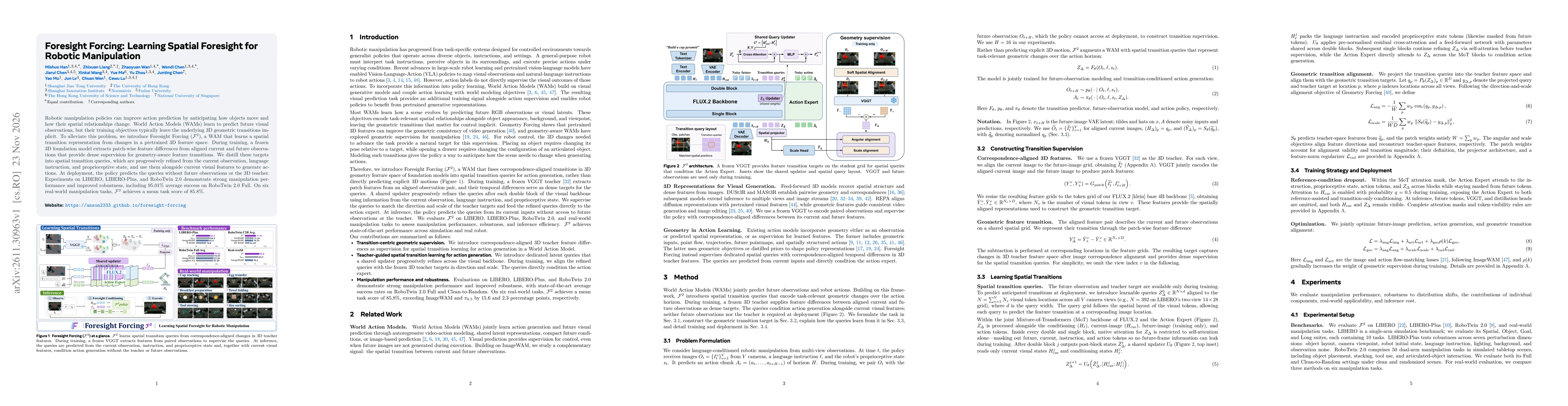
Robotic manipulation policies can improve action prediction by anticipating how objects move and how their spatial relationships change. World Action Models (WAMs) learn to predict future visual observations, but their training objectives typically leave the underlying 3D geometric transitions implicit. To alleviate this problem, we introduce Foresight Forcing ($\mathcal{F}^{2}$), a WAM that learns a spatial transition representation from changes in a pretrained 3D feature space. During training, a frozen 3D foundation model extracts patch-wise feature differences from aligned current and future observations that provide dense supervision for geometry-aware feature transitions. We distill these targets into spatial transition queries, which are progressively refined from the current observation, language instruction, and proprioceptive state, and use them alongside current visual features to generate actions. At deployment, the policy predicts the queries without future observations or the 3D teacher. Experiments on LIBERO, LIBERO-Plus, and RoboTwin2.0 demonstrate strong manipulation performance and improved robustness, including 95.01% average success on RoboTwin2.0 Full. On six real-world manipulation tasks, $\mathcal{F}^{2}$ achieves a mean task score of 85.8%.
Analysis
AI-generated · verify against the original paper
Generated Jan 1, 0001ResultsWhat the authors found
- Achieves 95.01% average success rate on the RoboTwin2.0 Full benchmark.
- Attains a mean task score of 85.8% across six real‑world manipulation tasks, surpassing ImageWAM and π0.5 by 15.6 and 2.3 percentage points respectively.
- Demonstrates state‑of‑the‑art performance on LIBERO, LIBERO‑Plus, and RoboTwin2.0 simulation suites with improved robustness under clean‑to‑random evaluation conditions.
MethodologyHow the work was done
Foresight Forcing (F²) trains a World Action Model by using a frozen pretrained 3D foundation model to extract patch‑wise feature differences between aligned current and future observations. These differences serve as dense supervision for geometry‑aware spatial transition queries, which are progressively refined using the current visual observation, language instruction, and proprioceptive state, and then combined with visual features to generate actions. At inference the model predicts the queries without future observations or the 3D teacher.
SignificanceWhy the work matters
The work shows that explicit geometry‑aware supervision via 3D feature transitions can substantially improve the predictive foresight and robustness of robotic manipulation policies, bridging the gap between visual prediction and actionable spatial reasoning.
Technical contributionsWhat the work introduces
Introduces a transition‑centric geometric supervision scheme that distills correspondence‑aligned 3D feature differences into latent spatial transition queries, and integrates these queries with multimodal inputs to condition action generation in a World Action Model.
NoveltyHow it differs from prior work
First to leverage dense patch‑wise differences from a frozen 3D foundation model as supervision for learning spatial transition representations within a World Action Model, enabling foresight without requiring future observations at deployment.
Discussion 0