From the Deterministic Hook Effect to Stochastic Reliability in Ternary Complex Formation
Abstract
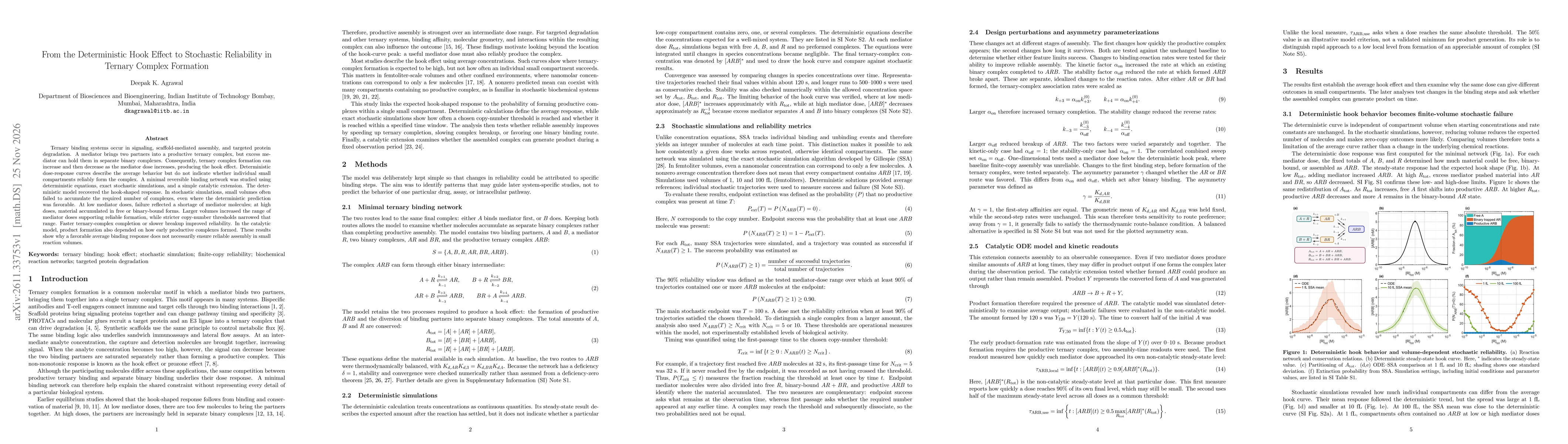
Ternary binding systems occur in signaling, scaffold-mediated assembly, and targeted protein degradation. A mediator brings two partners into a productive ternary complex, but excess mediator can hold them in separate binary complexes. Consequently, ternary complex formation can increase and then decrease as the mediator dose increases, producing the hook effect. Deterministic dose-response curves describe the average behavior but do not indicate whether individual small compartments reliably form the complex. A minimal reversible binding network was studied using deterministic equations, exact stochastic simulations, and a simple catalytic extension. The deterministic model recovered the hook-shaped response. In stochastic simulations, small volumes often failed to accumulate the required number of complexes, even where the deterministic prediction was favorable. At low mediator doses, failure reflected a shortage of mediator molecules; at high doses, material accumulated in free or binary-bound forms. Larger volumes increased the range of mediator doses supporting reliable formation, while stricter copy-number thresholds narrowed that range. Faster ternary-complex completion or slower breakup improved reliability. In the catalytic model, product formation also depended on how early productive complexes formed. These results show why a favorable average binding response does not necessarily ensure reliable assembly in small reaction volumes.
Analysis
AI-generated · verify against the original paper
Generated Jan 1, 0001ResultsWhat the authors found
- Deterministic calculations reproduced the classic hook-shaped dose‑response curve.
- Stochastic simulations revealed that small reaction volumes often fail to achieve the required number of ternary complexes even when deterministic predictions are favorable.
- Failure at low mediator doses was due to insufficient mediator molecules, while at high doses it resulted from sequestration in free or binary complexes.
- Increasing the reaction volume expanded the mediator dose range that supports reliable ternary complex formation.
- Stricter copy‑number thresholds narrowed the reliable dose window.
- Accelerating ternary‑complex completion or slowing its dissociation improved reliability.
- In the catalytic model, the amount of product formed depended on how early productive ternary complexes were generated.
LimitationsWhere the findings need caution
- The model is highly simplified and does not capture system‑specific details such as multiple binding sites or allosteric effects.
- Results are based on in silico simulations without experimental validation.
- The analysis focuses on a single mediator and two partners, limiting direct applicability to more complex networks.
MethodologyHow the work was done
The study used a minimal reversible ternary binding network analyzed with deterministic differential equations, exact stochastic simulations (Gillespie algorithm), and a simple catalytic extension to assess product formation.
SignificanceWhy the work matters
The work demonstrates that average deterministic binding responses can be misleading for small compartments, highlighting the importance of stochastic reliability for applications such as targeted protein degradation and nanoscale assays.
Technical contributionsWhat the work introduces
Provides a combined deterministic‑stochastic modeling approach that quantifies the reliability of ternary complex assembly across different compartment sizes and kinetic regimes.
NoveltyHow it differs from prior work
First study to link the deterministic hook effect with stochastic reliability, revealing how compartment volume and kinetic parameters govern the probability of successful ternary complex formation.
Future workQuestions that remain
- Extend the framework to more realistic biochemical networks with multiple mediators and allosteric regulation.
- Validate the stochastic reliability predictions experimentally in femtoliter‑scale compartments.
- Investigate the impact of spatial heterogeneity and diffusion on ternary complex formation.
Discussion 0