Abstract
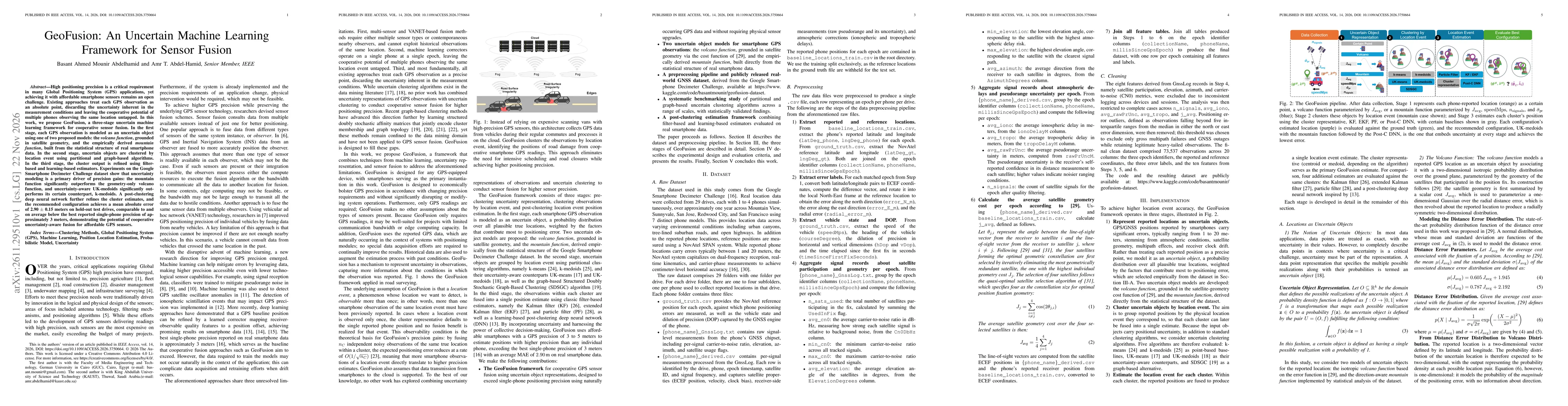
High positioning precision is a critical requirement in many Global Positioning System (GPS) applications, yet achieving it with affordable smartphone sensors remains an open challenge. Existing approaches treat each GPS observation as an absolute point, discarding the uncertainty inherent in the measurement conditions and leaving the cooperative potential of multiple phones observing the same location untapped. In this work, we propose GeoFusion, a three-stage uncertain machine learning framework for cooperative sensor fusion. In the first stage, each GPS observation is modeled as an uncertain object using one of two proposed models: the volcano function, grounded in satellite geometry, and the empirically derived mountain function, built from the statistical structure of real smartphone data. In the second stage, uncertain objects are clustered by location event using partitional and graph-based algorithms. In the third stage, the cluster output is refined using filter-based and learning-based estimators. Experiments on the Google Smartphone Decimeter Challenge dataset show that uncertainty modeling is a primary driver of precision gains: the mountain function significantly outperforms the geometry-only volcano function, and uncertainty-aware UK-medoids significantly outperforms its certain counterpart, k-medoids. A post-clustering deep neural network further refines the cluster estimates, and the recommended configuration achieves a mean absolute error of 2.90 +/- 0.15 meters on held-out test drives, comparable to and on average below the best reported single-phone precision of approximately 3 meters, demonstrating the potential of cooperative uncertainty-aware fusion for affordable GPS sensors.
AI Key Findings
Get AI-generated insights about this paper's methodology, results, significance, and more — available when analysis has been generated.
Discussion 0