Good Recognition is Non-Metric
Their study suggests that locally metric algorithms may not always be the best approach and that incorporating external knowledge can lead to effective solutions for the broader recognition problem.
Abstract
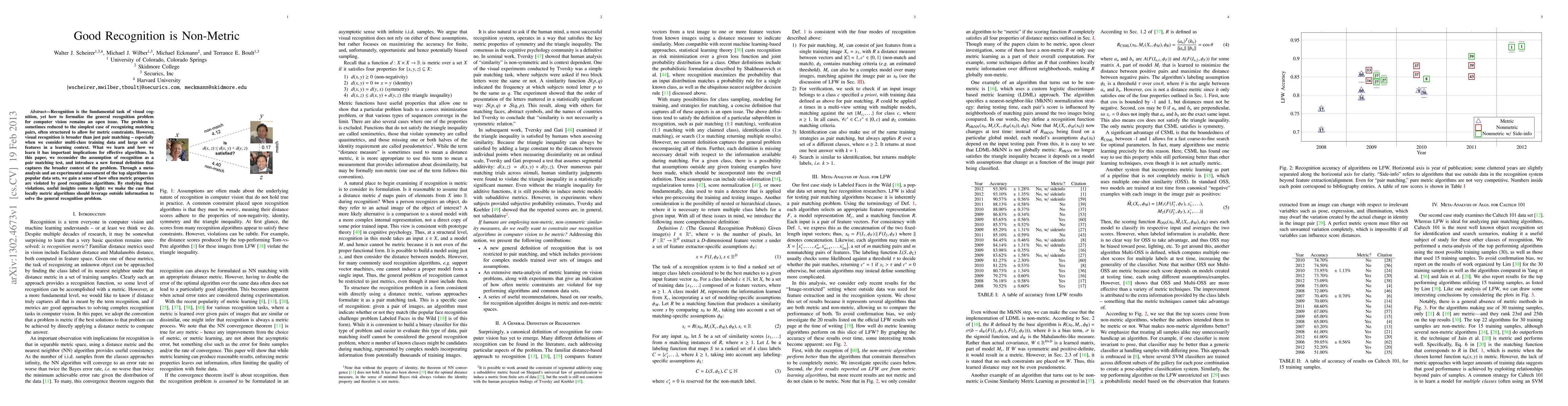
Recognition is the fundamental task of visual cognition, yet how to formalize the general recognition problem for computer vision remains an open issue. The problem is sometimes reduced to the simplest case of recognizing matching pairs, often structured to allow for metric constraints. However, visual recognition is broader than just pair matching -- especially when we consider multi-class training data and large sets of features in a learning context. What we learn and how we learn it has important implications for effective algorithms. In this paper, we reconsider the assumption of recognition as a pair matching test, and introduce a new formal definition that captures the broader context of the problem. Through a meta-analysis and an experimental assessment of the top algorithms on popular data sets, we gain a sense of how often metric properties are violated by good recognition algorithms. By studying these violations, useful insights come to light: we make the case that locally metric algorithms should leverage outside information to solve the general recognition problem.
AI Key Findings
Get AI-generated insights about this paper's methodology, results, significance, and more — available when analysis has been generated.
Discussion 0