GRAIN: Shared-Budget Complementary Re-observation for Object Detection
Abstract
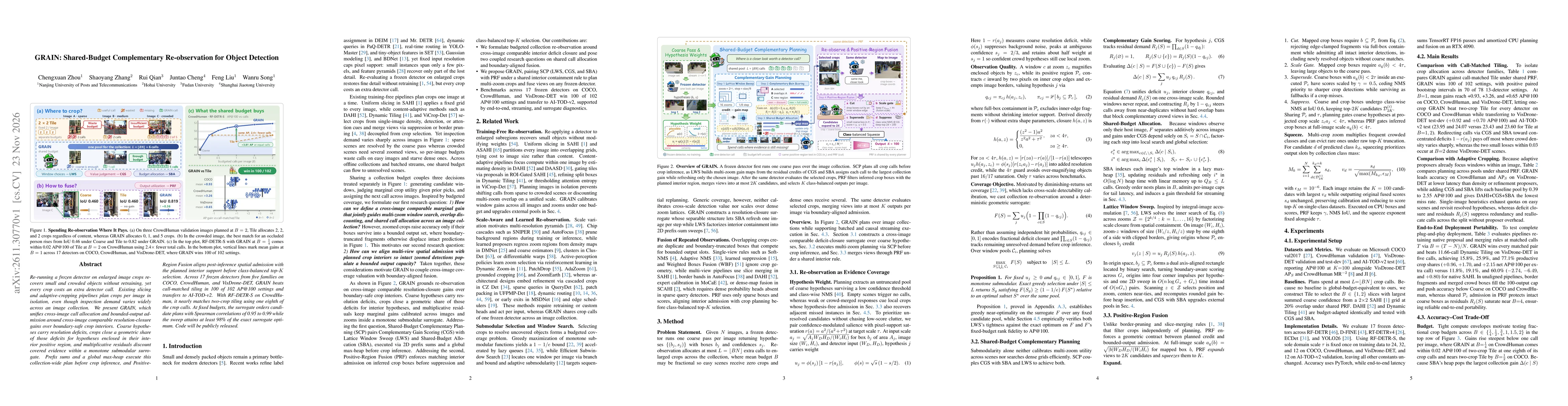
Re-running a frozen detector on enlarged image crops recovers small and crowded objects without retraining, yet every crop costs an extra detector call. Existing slicing and adaptive-cropping pipelines plan crops per image in isolation, even though inspection demand varies widely across an image collection. We present GRAIN, which unifies cross-image call allocation and bounded-output admission around cross-image comparable resolution-closure gains over boundary-safe crop interiors. Coarse hypotheses carry resolution deficits, crops close a geometric share of those deficits for hypotheses enclosed in their interior positive region, and multiplicative residuals discount covered evidence within a monotone submodular surrogate. Prefix sums and a global max-heap execute this collection-wide plan on CPU before crop inference, and Positive-Region Fusion aligns post-inference spatial admission with the planned interior support before class-balanced top- selection. Across 17 frozen detectors from five families on COCO, CrowdHuman, and VisDrone-DET, GRAIN beats call-matched tiling in 100 of 102 AP@100 settings and transfers to AI-TOD-v2. With RF-DETR-S on CrowdHuman, it nearly matches two-crop tiling using one eighth of the crop calls. At fixed budgets, the surrogate orders candidate plans with Spearman correlations of 0.95 to 0.99 while the sweep attains at least 98% of the exact surrogate optimum. Code will be publicly released.
Analysis
AI-generated · verify against the original paper
Generated Jan 1, 0001ResultsWhat the authors found
- GRAIN beats call‑matched tiling in 100 of 102 AP@100 settings across 17 frozen detectors on COCO, CrowdHuman, and VisDrone‑DET.
- Mean AP gains over tiling are +0.93 on COCO, +3.26 on CrowdHuman, and +0.65 on VisDrone‑DET.
- With RF‑DETR‑S on CrowdHuman, GRAIN achieves near‑tile performance using only one‑eighth of the crop calls.
- The surrogate ordering of candidate plans correlates with Spearman 0.95–0.99 to the exact gain, and the sweep attains at least 98% of the exact surrogate optimum.
- Positive‑Region Fusion improves true positives while reducing false positives (e.g., +6 TP / –27 FP on COCO with balanced NMS).
MethodologyHow the work was done
GRAIN formulates a shared-budget complementary planning (SCP) that pairs Complementary Gain Scoring (CGS) with a Lattice Window Sweep (LWS) and Shared-Budget Allocation (SBA), implemented via 2D prefix sums and a global max‑heap to select crops across an image collection before inference. After crop inference, Positive‑Region Fusion (PRF) aligns spatial admission of detections with the planned interior support, followed by class‑balanced top‑K selection.
SignificanceWhy the work matters
GRAIN enables training‑free, budget‑aware re‑observation that substantially improves detection of small and crowded objects without retraining detectors, offering a practical solution for large‑scale deployments with limited inference budgets.
Technical contributionsWhat the work introduces
Introduces a unified cross‑image budget allocation framework combined with boundary‑aligned fusion, leveraging a monotone submodular surrogate and efficient data structures to plan and execute complementary crops for frozen detectors.
NoveltyHow it differs from prior work
First method to share a fixed crop budget across an image collection using complementary gain scoring and positive‑region fusion, providing collection‑wide optimal re‑observation without modifying detector weights.
Discussion 0