Graph diffusion transformer for interpretable generation and inverse design of disordered atomic structures
Abstract
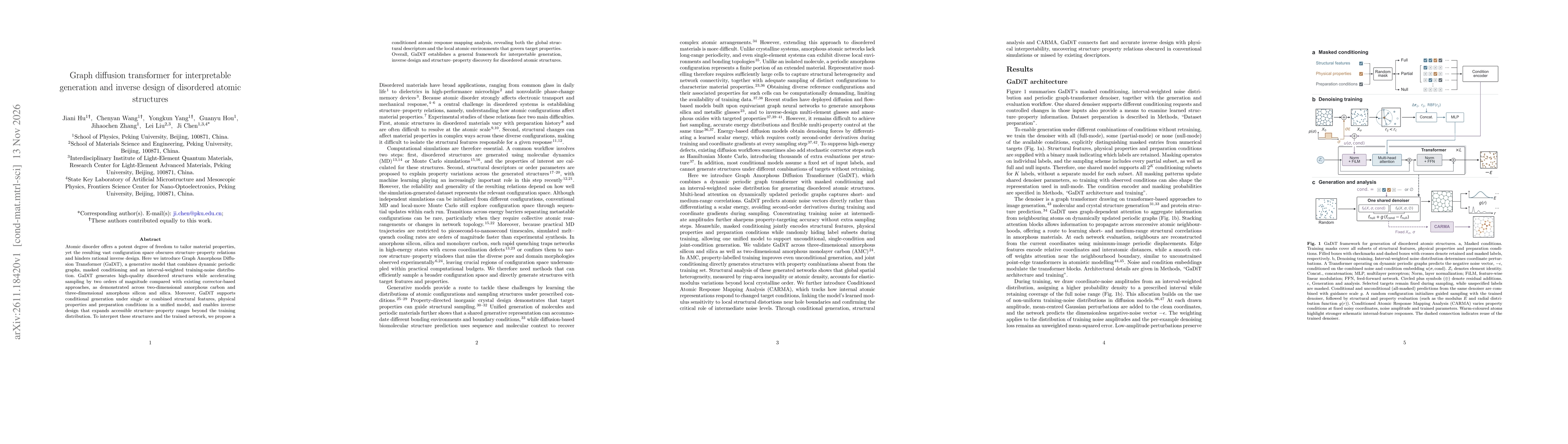
Atomic disorder offers a potent degree of freedom to tailor material properties, yet the resulting vast configuration space obscures structure-property relations and hinders rational inverse design. Here we introduce Graph Amorphous Diffusion Transformer (GaDiT), a generative model that combines dynamic periodic graphs, masked conditioning and an interval-weighted training-noise distribution. GaDiT generates high-quality disordered structures while accelerating sampling by two orders of magnitude compared with existing corrector-based approaches, as demonstrated across two-dimensional amorphous carbon and three-dimensional amorphous silicon and silica. Moreover, GaDiT supports conditional generation under single or combined structural features, physical properties and preparation conditions in a unified model, and enables inverse design that expands accessible structure-property ranges beyond the training distribution. To interpret these structures and the trained network, we propose a conditioned atomic response mapping analysis, revealing both the global structural descriptors and the local atomic environments that govern target properties. Overall, GaDiT establishes a general framework for interpretable generation, inverse design and structure-property discovery for disordered atomic structures.
AI Key Findings — Failed
Key findings could not be generated. Please try again later.
Discussion 0