Hamiltonian Dynamics Learning: A Scalable Approach to Quantum Process Characterization
This paper proposes an efficient quantum process learning method for short-time Hamiltonian dynamics, achieving scalable characterization without the resource constraints of conventional quantum process tomography. The method reconstructs quantum circuits from measurement data, enabling applications in quantum machine learning and benchmarking for noisy quantum hardware.
Abstract
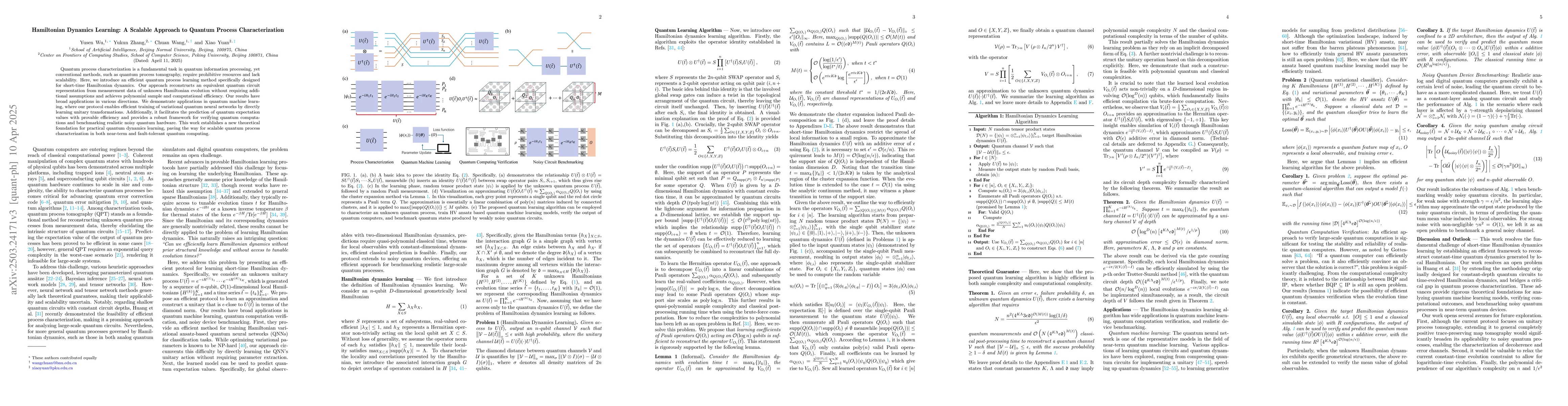
Quantum process characterization is a fundamental task in quantum information processing, yet conventional methods, such as quantum process tomography, require prohibitive resources and lack scalability. Here, we introduce an efficient quantum process learning method specifically designed for short-time Hamiltonian dynamics. Our approach reconstructs an equivalent quantum circuit representation from measurement data of unknown Hamiltonian evolution without requiring additional assumptions and achieves polynomial sample and computational efficiency. Our results have broad applications in various directions. We demonstrate applications in quantum machine learning, where our protocol enables efficient training of variational quantum neural networks by directly learning unitary transformations. Additionally, it facilitates the prediction of quantum expectation values with provable efficiency and provides a robust framework for verifying quantum computations and benchmarking realistic noisy quantum hardware. This work establishes a new theoretical foundation for practical quantum dynamics learning, paving the way for scalable quantum process characterization in both near-term and fault-tolerant quantum computing.
Analysis
AI-generated · verify against the original paper
Generated Jun 10, 2025ResultsWhat the authors found
- Development of an efficient quantum process learning method for short-time Hamiltonian dynamics.
- Achieving polynomial sample and computational efficiency, applicable to both near-term and fault-tolerant quantum computing.
- Demonstrated applications in quantum machine learning, enabling efficient training of variational quantum neural networks and prediction of quantum expectation values.
- Provided a robust framework for verifying quantum computations and benchmarking realistic noisy quantum hardware.
LimitationsWhere the findings need caution
- The method's efficiency is limited to short-time Hamiltonian dynamics; deeper circuits may lead to inefficiencies.
- The approach assumes local Hamiltonians, which might not cover all types of quantum processes encountered in practical quantum computing.
MethodologyHow the work was done
The research introduces a scalable approach for quantum process characterization using Hamiltonian dynamics learning, which reconstructs an equivalent quantum circuit representation from measurement data of unknown Hamiltonian evolution without additional assumptions, achieving polynomial sample and computational efficiency.
SignificanceWhy the work matters
This work establishes a new theoretical foundation for practical quantum dynamics learning, crucial for scalable quantum process characterization, with broad applications in quantum information processing.
Technical contributionsWhat the work introduces
The paper presents a novel learning algorithm for quantum processes based on Hamiltonian dynamics, which reconstructs quantum circuits from measurement data without additional assumptions, ensuring polynomial resource efficiency.
NoveltyHow it differs from prior work
The approach distinguishes itself by focusing on Hamiltonian dynamics, offering a scalable solution for quantum process characterization that outperforms conventional methods like quantum process tomography in terms of resource requirements.
Future workQuestions that remain
- Explore extensions of the method to longer-time Hamiltonian dynamics.
- Investigate applicability to non-local Hamiltonians and more complex quantum processes.
Discussion 0