Hard Gate Knowledge Distillation -- Leverage Calibration for Robust and Reliable Language Model
This paper proposes a hard gate knowledge distillation method leveraging model calibration to enhance language model robustness and reliability. By using a teacher model to detect student miscalibration, the method alternates between learning from the teacher and training data, improving generalization and reducing calibration error.
Abstract
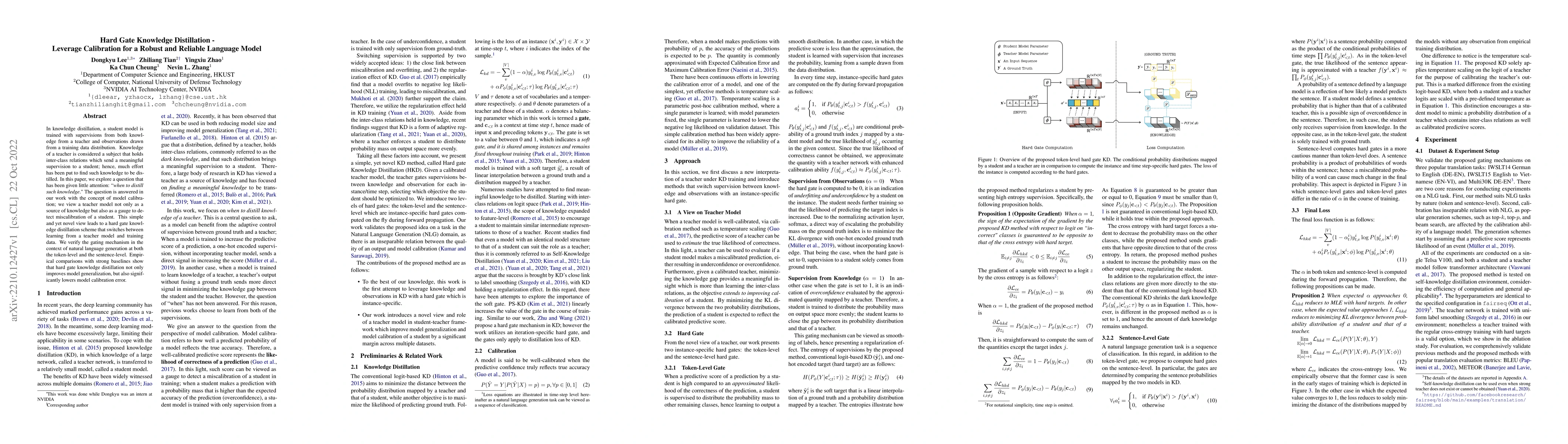
In knowledge distillation, a student model is trained with supervisions from both knowledge from a teacher and observations drawn from a training data distribution. Knowledge of a teacher is considered a subject that holds inter-class relations which send a meaningful supervision to a student; hence, much effort has been put to find such knowledge to be distilled. In this paper, we explore a question that has been given little attention: "when to distill such knowledge." The question is answered in our work with the concept of model calibration; we view a teacher model not only as a source of knowledge but also as a gauge to detect miscalibration of a student. This simple and yet novel view leads to a hard gate knowledge distillation scheme that switches between learning from a teacher model and training data. We verify the gating mechanism in the context of natural language generation at both the token-level and the sentence-level. Empirical comparisons with strong baselines show that hard gate knowledge distillation not only improves model generalization, but also significantly lowers model calibration error.
AI Key Findings
Get AI-generated insights about this paper's methodology, results, significance, and more — available when analysis has been generated.
Discussion 0