Hi-Token: Hierarchical Coordinate Tokenization for Generative Visual Grounding
Abstract
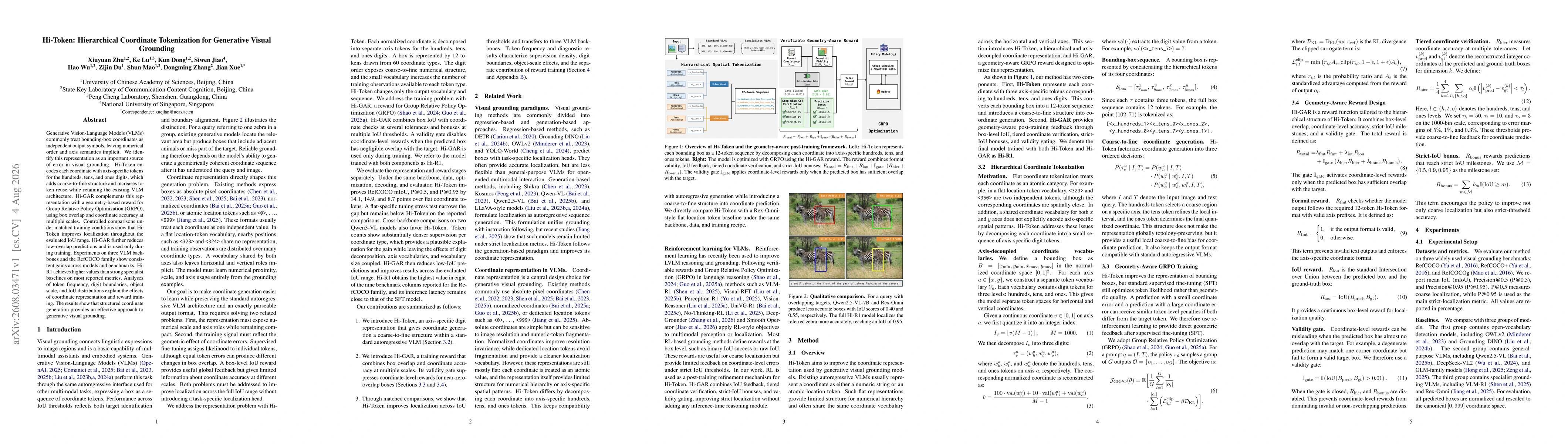
Generative Vision-Language Models (VLMs) express bounding boxes as coordinate sequences, whose token identities often leave axis and place value implicit. We study how explicitly encoding these roles improves visual grounding. Hi-Token assigns a distinct token to each combination of axis, decimal place, and digit value, representing a box with 12 tokens drawn from 60 types. This design exposes coarse-to-fine coordinate structure and increases token reuse relative to atomic location tokens while retaining the existing VLM architecture. Hi-GAR complements this representation with a geometry-based reward for Group Relative Policy Optimization (GRPO), combining box overlap, coordinate accuracy at multiple scales, strict-IoU bonuses, and validity gating. Matched training comparisons show that Hi-Token improves localization throughout the evaluated IoU range, with gains across three VLM backbones. Hi-Token also outperforms an additionally tuned atomic-token baseline on the RefCOCO family before reinforcement learning. Hi-GAR further improves localization and is used only during training. The resulting Hi-R1 model achieves higher values than strong specialist baselines on most reported metrics. Token-frequency and geometric diagnostics characterize the representation and reward stages. These results establish explicit axis and place-value encoding as an effective design for generative visual grounding. Project page: https://xyzzzh.github.io/Hi-Token/
Analysis
AI-generated · verify against the original paper
Generated Aug 6, 2026ResultsWhat the authors found
- Hi-Token improves localization across the IoU range, achieving gains in mIoU, [email protected], and [email protected] compared to flat-coordinate tokens under matched training conditions.
- Hi-GAR reduces low-overlap predictions and further enhances performance when used during training, improving robustness of predictions across IoU thresholds.
- Across three VLM backbones and RefCOCO benchmarks, Hi-R1 surpasses strong specialist baselines on most reported metrics, with consistent gains in localization metrics.
- Token-frequency and diagnostic analyses indicate that coordinate decomposition, axis-specific vocabularies, and reward training collectively drive the observed gains without needing task-specific localization heads.
LimitationsWhere the findings need caution
- Gains are reported under matched training conditions; real-world variability in data or unseen domains may affect performance.
- The approach introduces axis-specific tokens and a training-time reward, which may complicate tuning and require careful calibration across new backbones or datasets.
- The study analyzes three backbones and RefCOCO family; generalization to other grounding datasets remains to be validated.
MethodologyHow the work was done
Hi-Token proposes axis-specific tokens for hundreds, tens, and ones to decompose coordinates, creating a coarse-to-fine structured coordinate generation within a standard autoregressive VLM. Hi-GAR adds a geometry-based training reward (GRPO) that combines box IoU with coordinate checks at multiple tolerances and scales, with a validity gate to disable coordinate-level rewards for negligible overlap; Hi-GAR is used only during training, and evaluations compare Hi-Token with and without GRPO under matched conditions across three backbones and the RefCOCO family.
SignificanceWhy the work matters
Demonstrates that structured coordinate generation and geometry-aware training rewards can substantially improve generative visual grounding without altering the underlying VLM architecture, enabling better boundary alignment and robustness across models and benchmarks.
Technical contributionsWhat the work introduces
Introduction of Hi-Token, an axis-specific hierarchical coordinate tokenization decomposing each coordinate into hundreds, tens, and ones tokens; introduction of Hi-GAR, a GRPO-based training reward combining IoU-based criteria with multi-scale coordinate checks and a validity gate to suppress coordinate rewards when overlap is negligible; comprehensive empirical validation showing improved localization across multiple backbones and the RefCOCO family.
NoveltyHow it differs from prior work
Presents a novel coordinate representation that exposes numerical scale and axis roles within a standard autoregressive VLM and pairs it with a geometry-aware training reward, enabling improved localization without architectural changes to the inference model.
Future workQuestions that remain
- Explore extending Hi-Token to more axes or dimensionalities (e.g., 3D bounding boxes) for richer spatial reasoning.
- Investigate automatic ablation studies across more backbones and datasets to quantify robustness of tokenization and GRPO components.
- Develop more efficient training schedules or normalization to further reduce training-time overhead from the GRPO reward.
Discussion 0